Categories
exercises Fitness fitness-tips flexibility flexibility & mobility Gym home workout men recovery & wellness strength training stretching women yogis

Pre-Workout Stretching Plan for Yogis: Enhancing Flexibility & Mobility

For yogis, preparing the body before any intense workout or practice session is essential—not only to prevent injury but to maximize flexibility and mobility. Stretching is often seen as a simple warm-up step, but when done mindfully and with intention, it becomes a powerful tool to enhance your fitness journey and deepen your practice.

In this article, we’ll explore a practical pre-workout stretching plan tailored specifically for yogis. Whether you’re preparing for a vigorous yoga flow, strength training, or cardio session, these targeted stretches will set the stage for optimal performance and wellness.

Why Focus on Flexibility & Mobility?

Flexibility refers to the ability of your muscles to lengthen, while mobility is about the range of motion in your joints. Together, they form the foundation of functional movement and injury prevention. For yogis, maintaining both is crucial—not just to perform asanas with grace but to safeguard the body during dynamic workouts.

When you prioritize flexibility and mobility in your pre-workout routine, you increase blood flow, reduce muscle stiffness, and enhance joint lubrication.

The Pre-Workout Stretching Plan for Yogis

  1. Dynamic Cat-Cow Flow (Spinal Mobility)

Instructions:

Start on all fours, placing your hands directly below your shoulders and your knees beneath your hips.

Take a deep breath in as you gently curve your spine downward, dropping your abdomen toward the mat, lifting your chest, and raising your hips.

Exhale as you round your back toward the ceiling, tuck your chin in, and engage your abdominal muscles lightly (Cat Pose).

Repeat this motion with your breath for 8–10 cycles, allowing each movement to feel smooth and intentional.

Benefits: Helps loosen the spine, enhances range of motion, and encourages smooth, controlled movement.

  1. Standing Side Stretch (Lateral Flexibility)

Instructions:

Position yourself upright, feet spaced roughly at shoulder distance, with your arms resting comfortably alongside your body.

Inhale and raise your right arm overhead, keeping your shoulders relaxed.

Exhale as you lean gently to the left, feeling a stretch along your right side body. Keep your hips squared forward.

Hold this stretch for 15–20 seconds, then return to standing.

Repeat on the opposite side.

Benefits: Opens up the side body, improves lateral flexibility and breathing capacity.

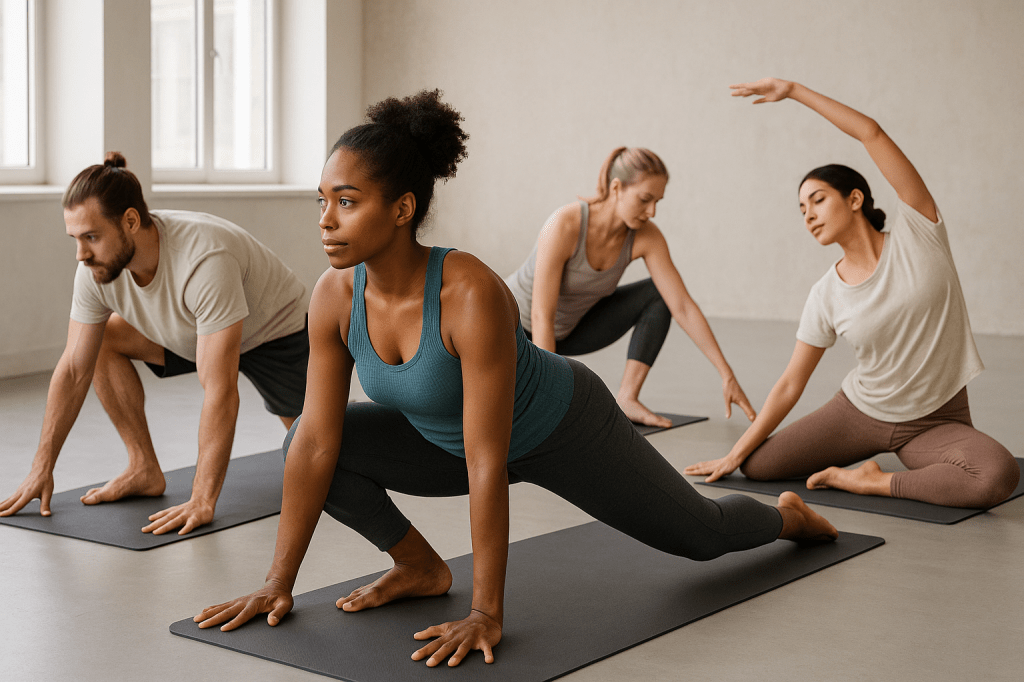
  1. Low Lunge with Twist (Hip Mobility & Spinal Rotation)

Instructions:

Step your right foot forward between your hands, lowering your left knee to the mat into a low lunge position.

Look up toward your extended hand and maintain the twist for about 20 seconds.

Return your hand to the mat and switch sides.

Benefits: Loosens tight hips, stretches hip flexors, and improves spinal mobility.

  1. Downward Dog Pedal (Calf & Hamstring Flexibility)

Instructions:

From a Downward Dog position (hands and feet on the mat, hips lifted high), begin to pedal your feet.

Lower your right heel toward the floor, bending your left knee slightly.

Next, alternate by pressing your left heel down as you bend your right knee.

  1. Wrist Circles and Finger Stretch (Joint Mobility)

Instructions:

Stretch your arms forward, keeping your palms directed downward.

Rotate your wrists slowly clockwise 10 times, then counterclockwise 10 times.

Next, spread your fingers wide apart and hold for 10 seconds.

Relax and repeat the finger stretch 2–3 times.

Benefits: Prepares wrists and fingers for weight-bearing postures, reduces stiffness, and increases joint mobility.

Benefits of a Pre-Workout Stretching Routine for Yogis

Injury Prevention: Warming up your muscles gradually helps lower the chances of pulls, strains, or other workout-related injuries.

Improved Performance: Enhanced joint mobility enables deeper, more precise movements.

Greater Mind-Body Connection: Focused stretching increases body awareness and mental readiness.

Enhanced Recovery: Prepping muscles reduces soreness after intense sessions.

Final Thoughts

Building a consistent pre-workout stretching habit is one of the most effective ways to honor your body and boost your fitness. For yogis especially, flexibility and mobility are more than physical attributes—they’re gateways to a richer, more mindful practice. Integrate these stretches into your routine and feel the difference in your next session.
Categories
Fitness flexibility & mobility Gym home workout mobility nutrition nutrition & meal recovery & wellness strength training stretching women yogis

Daily Mobility Routine to Prevent Injuries in Yogis

Whether you’re easing into your first downward dog or moving through advanced asanas, the key to a sustainable yoga practice isn’t just flexibility — it’s mobility. This short, effective daily routine supports joint health, reduces injury risk, and enhances your overall movement quality.

What’s the Difference Between Flexibility & Mobility?

Flexibility is how far a muscle can stretch.

Mobility is how well a joint moves under control through that range.

Yoga already boosts flexibility. But when we train mobility, we strengthen those flexible ranges so they’re more resilient — which is critical for preventing injuries.

Your 10-Minute Daily Mobility Routine for Yogis

No equipment needed. Just your body, your breath, and about 10 minutes of focused, mindful movement.

  1. Controlled Shoulder Circles (CARs)

Purpose: Helps unlock the shoulder joint while improving strength and control throughout your range of motion.

Instructions:

Stand or sit tall.

Extend one arm straight out in front of you.

Slowly move it in a full circle overhead and behind, like you’re tracing the biggest circle possible.

Keep the rest of your body still.

Reverse direction after 5 reps.

Reps: 5 slow circles in each direction per arm.

  1. Cat-Cow with Core Engagement

Why: Mobilizes your spine while training breath and core control.

Instructions:

Start on hands and knees.

Inhale: Arch your back, lifting your tailbone and chest (Cow).

Exhale: Gently curve your spine upward, drawing your chin toward your chest and tucking your pelvis under.

Focus on moving one vertebra at a time.

Time: 1 minute of slow, controlled reps.

  1. 90/90 Hip Switches

Why: Opens hips and strengthens rotational movement.

Instructions:

Sit down with both knees bent — position one leg in front of you and the other out to the side, forming roughly 90-degree angles at each knee.

Keep your chest tall.

Carefully twist your hips to move both legs over to the other side, making sure your hands stay lifted off the floor.

Control the motion — avoid rushing.

Reps: 10 switches total (5 per side).

  1. Lunge with Spinal Twist

Why: Stretches hip flexors and thoracic spine — key for many yoga poses.

Instructions:

Step one foot forward into a deep lunge.

Place opposite hand on the floor.

Lift your opposite arm toward the ceiling as you rotate your torso to face your front leg.

Hold 2–3 breaths, then switch.

Reps: 5 reps per side.

  1. Deep Squat Hold with Arm Reaches

Why: Improves ankle, hip, and thoracic mobility.

Instructions:

Stand with feet hip-width apart.

Sink into a deep squat (heels down if possible).

Extend one arm upward as you gently press the opposite elbow against the inside of your knee for support.

Switch arms slowly.

Time: Hold the squat for 1–2 minutes, alternating arm reaches every 20 seconds.

  1. Downward Dog to Plank Rolls

Why: Engages shoulders, spine, and core control through transitions.

Instructions:

Start in Downward Dog.

Roll your spine forward into Plank position, stacking shoulders over wrists.

Roll back into Downward Dog with control.

Avoid collapsing — move smoothly.

Reps: 10 reps total.

  1. Supine Glute Bridge with Knee Pull

Why: Activates glutes, mobilizes hips, and stretches hamstrings.

Instructions:

Position yourself lying on your back, with your knees bent and feet placed about hip-distance apart.

Lift hips into a bridge, then pull one knee toward your chest.

Hold for 2–3 seconds, return foot to floor, repeat on the other side.

Reps: 10 reps each side.

Helpful Tips for Staying Consistent

Pair it with an existing habit (like brushing teeth or before yoga).

Use a timer so you don’t overthink it — just flow.

Stay present. Each rep is a chance to reconnect with your body.

Benefits for Yogis

Reduces injury risk during dynamic flows or deep stretches

Improves joint strength and body control

Supports smoother transitions between poses

Enhances body awareness on and off the mat

Encourages sustainable, long-term movement

Final Thought

Yoga is about more than being flexible — it’s about moving with intention, grace, and control. This mobility routine strengthens the foundation that supports your practice. Add it to your daily rhythm and feel the difference in how you move, stretch, and flow.