Categories
gear & reviews home workout men Muscle Gain recovery recovery & wellness resistance bands strength training stretching

Top 5 Muscle Gain Resistance Bands for Home Workouts

When you think of muscle gain, resistance bands might not be the first tool that comes to mind — but they should be. Resistance bands create constant tension on the muscles, promote joint stability, and mimic many gym movements without the bulk or cost of equipment. Whether you’re working out in your living room, garage, or on the road, the right bands can help you build strength and size — effectively and safely.

Below are the top 5 resistance bands for home workouts, complete with gear & reviews, muscle gain tips, and step-by-step usage instructions to get the most out of each set.

  1. Serious Steel Resistance Bands

Why we love them:

These layered latex bands are extremely durable and offer a wide resistance range — from light mobility work to heavy compound lifts.

Best for: Intermediate to advanced lifters

How to use:

Band-Assisted Pull-Ups:

Loop the band over a pull-up bar, place one or both feet in the band, and perform controlled pull-ups to build back and biceps.

Banded Deadlifts:

Stand on the band with feet shoulder-width apart, grab both ends, and perform deadlifts by hinging at the hips. Focus on squeezing glutes at the top.

Pro Tip: Use the red or black band for isolation, and green or purple for heavier compound moves.

  1. Undersun Fitness Resistance Bands Set

Why we love them:

Designed by fitness pro James Grage, this set includes five bands with training programs that target hypertrophy — no weights needed.

Best for: Anyone wanting a full program without the guesswork

How to use:

Chest Press:

Secure the band by looping it around a heavy, stable surface or using a door anchor for support. Hold handles at chest level and press forward, just like a dumbbell press.

Band Rows:

Place your feet on the band and pull the handles in toward your waist, keeping your elbows close to your body. Perfect for building a thick back.

  1. Rogue Monster Bands

Why we love them:

Engineered for intensity, Rogue’s bands are a go-to for athletes and lifters who want explosive strength and long-term durability.

Best for: Power and strength-based movements

How to use:

Banded Squats:

Position the band beneath your feet and drape it across your shoulders. Perform controlled squats, focusing on tension throughout the movement.

Explosive Push-Ups:

Wrap the band around your back and hold ends under palms. Perform push-ups with added resistance for chest and triceps.

Pro Tip: Use lighter bands for speed work, heavier bands for controlled negatives.

  1. Fit Simplify Resistance Loop Bands

Why we love them:

Compact and great for beginners, these loop bands are ideal for high-rep work, glute activation, and toning circuits.

Best for: Beginners or muscle endurance training

How to use:

Glute Bridges:

Place the band just above your knees, lie on your back with knees bent, and lift hips while pressing knees outward.

Lateral Band Walks:

Move laterally while maintaining a half-squat stance to activate your glute and hip muscles. Great as a warm-up or finisher.

Pro Tip: Use as activation before heavy leg days for better muscle recruitment.

  1. Bodylastics Resistance Band Set

Why we love them:

With reinforced inner cords to prevent snapping and modular handles, Bodylastics brings the most complete home band setup available.

Best for: Full-body training and safety-conscious users

How to use:

Overhead Shoulder Press:

Step on the band, hold handles at shoulder height, and press upward. Excellent for delts and upper traps.

Band Curls & Tricep Extensions:

Use the door anchor for curls or overhead extensions. Adjust resistance by clipping multiple bands.

Pro Tip: Try supersets (e.g., curls → press) to fatigue muscles and stimulate growth.

Final Thoughts

Resistance bands aren’t just for warmups or travel — they’re legitimate muscle-building tools that can deliver real gains at home. With the right technique and progression, you can replicate almost every gym movement, without the cost or bulk.

To make the most of your training:

Stick to 8–15 reps per set for hypertrophy

Control your tempo (especially during the lowering phase)

Increase resistance over time (add thicker bands or stack them)

Train consistently — bands only work if you do

Explore these top picks, follow the instructions, and you’ll be well on your way to building muscle on your own terms.


Categories
Fitness fitness-tips Muscle Gain recovery recovery & wellness training

Best Sleep Habits for Muscle Gain Recovery

One often overlooked pillar of recovery & wellness is sleep. Getting quality sleep is essential for muscle gain and overall fitness progress. In this article, we’ll dive into the best sleep habits to support your muscle recovery, maximize gains, and enhance your wellness journey — with easy instructions you can start using today.

Why Sleep Matters for Muscle Gain

During deep sleep phases, your body ramps up the production of growth hormone, a key player in muscle repair and growth. Sleep also helps reduce inflammation and restore energy levels, preparing your muscles for the next workout session. Without adequate rest, even the best exercise and diet plans can fall short.

Top Sleep Habits for Optimal Muscle Recovery — with Instructions

  1. Prioritize Consistent Sleep Schedules

Why: Consistency regulates your body’s internal clock and improves hormone balance.

How to do it:

Set a fixed bedtime and wake-up time.

Use alarms or phone reminders to keep you on track.

Prioritize Consistent Sleep Schedules

How to do it:

Try to keep your wake-up time within about an hour of your usual time, even on days off.

Set alarms or reminders to help maintain your routine.

  1. Aim for 7 to 9 Hours of Sleep

Why: Getting this amount allows your body to reach the deep and REM sleep phases needed for muscle repair.

How to do it:

Decide when you need to get up, then plan your bedtime so that you get between seven and nine hours of rest.

Make gradual changes to your schedule if you’re not currently getting enough sleep.

Adjust your schedule gradually if you’re currently sleeping less.

Track your sleep duration using a journal or sleep app.

  1. Create a Relaxing Bedtime Routine

Why: Helps your body wind down and fall asleep faster.

How to do it:

Spend 30 minutes before bed doing low-stimulation activities (reading, light stretching, meditation).

Turn off phones, computers, and TV to reduce blue light exposure.

Consider calming rituals like herbal tea or aromatherapy.

  1. Optimize Your Sleep Environment

Why: A comfortable, distraction-free room improves sleep quality.

How to do it:

Keep your bedroom temperature between 60-67°F (15-19°C).

Use blackout curtains or an eye mask to block light.

Invest in a supportive mattress and pillows suited to your comfort.

  1. Be Mindful of Pre-Sleep Nutrition

Why: Your food choices can influence both how quickly you fall asleep and how well your muscles recover.

How to do it:

Avoid caffeine and alcohol 4-6 hours before bedtime.

Skip heavy, spicy, or sugary foods late at night.

Eat a small protein-carb snack about 1 hour before bed, like a banana with peanut butter or Greek yogurt with berries.

  1. Manage Stress Throughout the Day

Why: High stress elevates cortisol, which can interfere with muscle repair and sleep.

How to do it:

Incorporate 5-10 minutes of mindfulness, deep breathing, or meditation daily.

Schedule regular physical activity that you enjoy.

Practice journaling or talk to a friend to process daily stressors.

Benefits of Good Sleep for Muscle Gain

Improved Muscle Recovery: Sleep stimulates the release of growth hormones and aids in building new muscle proteins.

Improved Performance: Well-rested muscles can handle more intense workouts.

Reduced Injury Risk: Fatigue-related injuries are less common with adequate rest.

Better Mental Wellness: Sleep supports mood and motivation, helping consistency.

Final Thoughts

Building muscle isn’t just about lifting heavier weights or eating more protein — your sleep habits play a vital role in your overall fitness and recovery & wellness journey. Follow these straightforward instructions to improve your sleep today and give your muscles the best environment to grow and recover.

Start treating sleep like an essential part of your training plan — your body will thank you for it!

Categories
Fitness home workout men Muscle Gain strength training women

How to Increase Bench Press in Muscle Gain Weeks

When it comes to muscle gain, there’s one move that remains a favorite in almost every gym: the bench press. But increasing your bench press — especially during dedicated muscle-building phases — requires more than just lifting heavier. It calls for a strategic approach to strength training, recovery, and execution.

Whether you’re chasing your first 225 or trying to smash through a plateau, here’s a guide packed with tips, techniques, and instructions to help you level up your bench press during muscle gain weeks.

  1. Use Progressive Overload – Every Single Week

What to do:

Gradually increase the load or volume of your bench press each week to push your muscles to adapt.

Instructions:

Start with a weight you can lift for 8–10 reps with good form.

Each week, increase the weight by 2.5–5 lbs, or add 1–2 more reps.

Keep your weekly increases small and steady to avoid injury and maximize growth.

Example Plan:

Week 1: 185 lbs × 8 reps

Week 2: 190 lbs × 8 reps

Week 3: 190 lbs × 10 reps

  1. Perfect Your Bench Press Form

Even small adjustments in form can lead to big strength gains and reduce the risk of injury.

Instructions:

Lie flat on the bench, eyes directly under the bar.

Firmly anchor your feet to the floor, positioning them slightly behind your hips to create full-body tension

Retract your shoulder blades and keep a slight arch in your lower back.

Grip the bar just wider than shoulder-width.

Bring the bar down in a controlled motion to the center of your chest, hold for a moment, then drive it upward with power.

Bonus Tip: Record yourself occasionally to check your form — small flaws can go unnoticed.

  1. Increase Weekly Training Volume

In muscle gain phases, higher training volume helps grow the muscle groups involved in pressing.

Instructions:

Incorporate bench press into your routine 2 to 3 times a week, using different variations to target muscle groups from multiple angles.

Day 1 (Strength Focus): 4 sets × 4–6 reps (heavy weight)

Day 2 (Volume Focus): 4–5 sets × 8–12 reps (moderate weight)

Day 3 (Variation): 3 sets × 10–12 reps of incline bench, dumbbells, or paused bench

Rest Between Sets:

Heavy sets: 2–3 minutes

Volume sets: 60–90 seconds

  1. Add Key Accessory Exercises

Accessory lifts build strength in the muscles that support the bench press.

Instructions:

Add 2–3 accessory movements after your main bench work:

Triceps: Skull crushers, triceps dips, rope pushdowns (3 sets × 10–15 reps)

Shoulders: Overhead press, lateral raises (3–4 sets × 8–12 reps)

Back: Barbell rows, face pulls, pull-ups (3–4 sets × 10–12 reps)

Pro tip: Building a stronger upper back enhances your stability and control during the bench press.

  1. Eat to Support Muscle Gain

Nutrition is half the battle.

Instructions:

Aim to consume roughly one gram of protein for every pound you weigh — for example, someone who weighs 180 pounds should target about 180 grams of protein daily

Carbs: Fuel your workouts — rice, oats, potatoes, fruit

Fats: Keep healthy fats in your diet (nuts, olive oil, eggs)

Hydration goal: Drink a minimum of 3 liters of water daily to support muscle function and recovery.

Pro Tip: Have a protein + carb meal within 60 minutes after training.

  1. Prioritize Sleep and Recovery

Muscles grow when you rest — not when you’re lifting.

Instructions:

Sleep 7–9 hours per night

Be sure to schedule at least one complete day off from training each week to allow your body to recover and rebuild.

Consider light stretching or foam rolling on off days to stay mobile

Avoid: Training through joint pain or chronic soreness. It stalls your progress.

  1. Track Progress and Stay Consistent

Instructions:

Use a workout log or app to track weight, reps, and rest times

Make notes on how each session felt

Adjust based on fatigue, not ego — more is not always better

Weekly Check-In Example:

“Bench: 205 × 5 felt strong. Try 210 next week. Triceps feeling tight — stretch post-lift.”

Summary

Improving your bench press during muscle gain weeks comes down to strategy. With consistent strength training, proper nutrition, and a smart training layout, you’ll build more than just numbers — you’ll build real, functional upper-body strength. Follow your routine consistently, stay patient with your progress, and keep your eyes on long-term results

Categories
beginners busy schedules cardio cardio & endurance exercises fat loss Fitness fitness-tips flexibility flexibility & mobility Gym home workout men mobility Muscle Gain strength training stretching training Treadmill

Treadmill Workout for Muscle Gain

When most people think of treadmill workouts, they imagine cardio and endurance sessions focused on weight loss or heart health. But with the right approach, treadmill training can also play a key role in muscle gain. This article explores how to optimize treadmill workouts to build muscle, improve cardio & endurance, and enhance your overall fitness.

Why Cardio & Endurance Matter for Muscle Gain

Building muscle isn’t just about lifting heavy weights — your cardiovascular system plays a vital supporting role. Improved endurance means you can sustain harder, longer workouts, which boosts muscle growth. Plus, better circulation from cardio helps deliver oxygen and nutrients to muscles, aiding recovery and hypertrophy.

Step-by-Step Treadmill Workout Instructions for Muscle Gain

Ready to start? Here’s a practical treadmill routine designed to target muscle building while boosting endurance:

  1. Warm-Up (5-10 minutes)

Start walking at a comfortable pace (2.5–3.5 mph).

Gradually increase the incline to 1-2%.

This helps get your muscles and heart ready for the upcoming exercise.

  1. Incline Walking for Muscle Activation (10 minutes)

Set the treadmill incline between 5-10%.

Walk briskly at 3.5–4.5 mph.

Maintain an upright posture while actively working your glute and hamstring muscles.

This targets lower-body muscles deeply, promoting strength and endurance.

  1. Interval Sprints (15 minutes)

Sprint at 7–9 mph for 30 seconds.

Slow down to a walk or light jog between 2.5 and 3.5 mph for about 90 seconds to catch your breath.

Repeat this cycle 6-8 times.

Sprinting recruits fast-twitch muscle fibers essential for muscle gain.

  1. Weighted Vest or Resistance Bands (Optional, 10 minutes)

If you have a weighted vest, wear it during walking or incline segments.

Alternatively, use resistance bands around your thighs while walking.

This extra resistance challenges muscles further, enhancing growth.

  1. Cool Down (5-10 minutes)

Slow down to a comfortable walk (2–3 mph).

Reduce the incline gradually to zero.

This aids recovery and prevents stiffness.

Additional Tips for Maximizing Muscle Gain

Consistency is key: Perform this workout 2-3 times per week alongside your strength training.

Proper nutrition is essential: provide your body with enough protein and energy to help muscles recover and grow.

Rest and recovery: Allow muscle groups time to recover between intense treadmill sessions.

Listen to your body: Adjust speed and incline based on your fitness level and goals.

Benefits of This Treadmill Approach

Builds leg muscle strength and endurance simultaneously.

Enhances cardiovascular fitness, allowing longer and more intense resistance workouts.

Speeds up recovery with active blood flow.

Boosts metabolism to support lean muscle gain.

Categories
Fitness flexibility mobility Muscle Gain

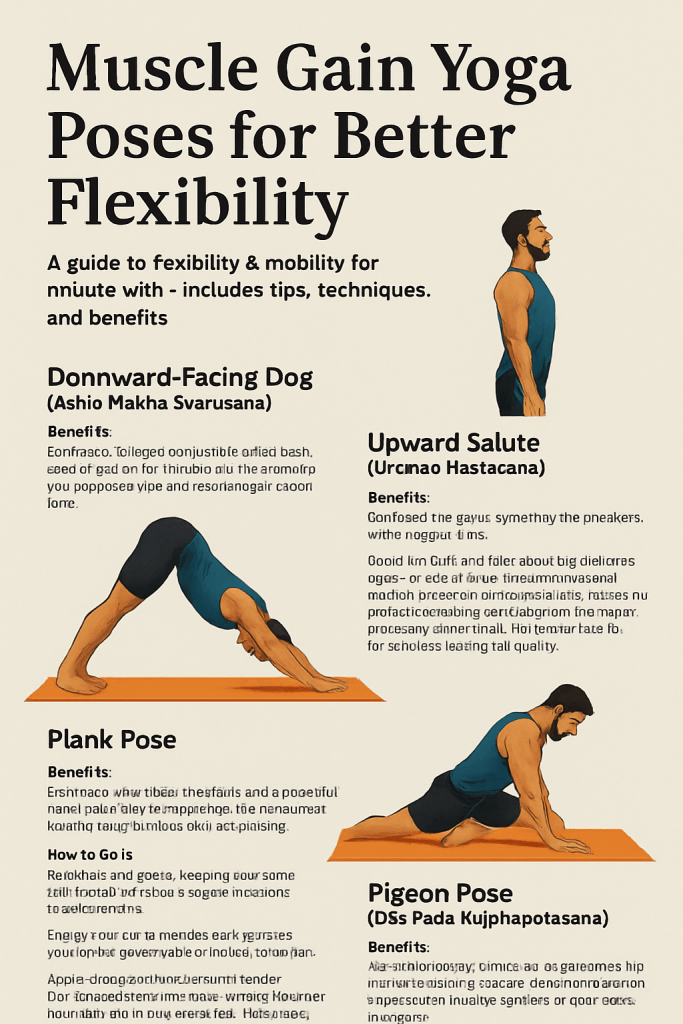
Muscle Gain Yoga Poses for Better Flexibility

Muscle gain isn’t just about lifting heavy or eating big—it’s also about how well your body moves. Incorporating yoga into your routine can significantly boost flexibility & mobility, which directly supports muscle development, recovery, and injury prevention.

This guide explores key yoga poses that improve flexibility while activating and supporting muscle growth. Each pose includes step-by-step instructions to help you practice safely and effectively.

Why Flexibility & Mobility Matter for Muscle Gain
Improved mobility means your muscles can move through a full range of motion, allowing for more efficient lifts and reduced injury risk. Tight, immobile joints lead to compensation, overuse, and plateaus in your fitness journey. Yoga helps by:

Increasing blood flow to muscles

Enhancing joint stability and alignment

Supporting recovery through active stretching

Enhancing movement quality so your muscles fire efficiently and safely under load.

Yoga Poses for Muscle Gain & Flexibility
Below are six beginner-to-intermediate poses, each selected to target areas crucial for strength training.

  1. Downward-Facing Dog (Adho Mukha Svanasana)
    This full-body stretch targets the entire back side of the body—from calves and hamstrings up through the spine—while also building strength in the shoulders, arms, and core. It’s a great pose for releasing tension and boosting circulation after a tough workout.

How to Do It:

Place your hands shoulder-width apart on the mat, with knees directly under your hips to establish a neutral stance.

Tuck your toes, lift your knees, and raise your hips toward the ceiling.

Work on straightening your legs gently, avoiding hyperextension of the knees.

Press your hands into the mat, keeping your spine long.

Maintain deep, steady breathing as you remain in the position for 30 to 60 seconds, allowing your muscles to ease and lengthen.

  1. Chair Pose (Utkatasana)
    Benefits:

    Activates quads, glutes, and back muscles while improving balance and core strength.

How to Do It:

Stand tall with feet together.

On your inhale, stretch both arms overhead, palms gently turned inward in a neutral position.

Exhale as you bend your knees, lowering your hips like sitting in a chair.

Focus on keeping your torso upright as you shift your weight toward your heels.

Hold for 30–60 seconds, then rise back up slowly.

  1. Low Lunge (Anjaneyasana)
    Benefits:

    Stretches tight hip flexors and strengthens legs—critical for squat depth and stride mobility.

How to Do It:

Step your right foot forward into a lunge, left knee down on the mat.

Ensure the right knee is directly above the ankle.

Raise both arms overhead and lift your chest.

Press your hips gently forward while keeping your back straight.

Hold for 30–45 seconds per side.

  1. Plank Pose
    Benefits:

    Develops strong, stable shoulders and a powerful core, while sharpening mental concentration—key elements for effective heavy lifting.

How to Perform:

Begin in a high plank position, with your arms straight and wrists aligned right under your shoulders.

Engage your core muscles and squeeze your glutes to maintain a strong, straight line from head to heels.

Avoid letting your hips dip or rise too high—aim for alignment.

Hold this position for 30 to 60 seconds, breathing evenly and with control.

  1. Pigeon Pose (Eka Pada Rajakapotasana)

Benefits:

This pose deeply stretches the glutes and hip rotators, helping to ease tension and improve lower-body mobility—perfect for post-training recovery.

How to Do It:

From Tabletop or Downward-Facing Dog, bring your right knee forward so it lands behind your right wrist.

Gently slide your right foot over toward your left wrist, allowing the shin to rest at an angle.

Extend your left leg straight behind you, keeping your toes pointing back.

Make sure your hips stay level—if they tilt, place a block under your right hip for support.

Gently lean forward, allowing your forearms to support you or letting your forehead rest softly on the mat.

Stay in the stretch for 1 to 2 minutes on each side, breathing deeply and allowing your body to release.

  1. Bridge Pose (Setu Bandha Sarvangasana)

Benefits:

It builds strength in the glutes and hamstrings, expands the chest, and enhances the mobility of the spine.

How to Do It:

Lie comfortably on your back, knees bent, and feet placed about hip-width apart.

Allow your arms to relax by your sides, palms resting softly on the mat with your shoulders grounded.

Push firmly through your heels to elevate your hips, using your glutes for a controlled, fluid movement.

Hold the pose for several breaths, then slowly lower down.

Hold for 1–2 minutes per side.

  1. Bridge Pose (Setu Bandha Sarvangasana)
    Benefits:

    This pose activates and strengthens the glutes and hamstrings, lifts and opens the chest, and promotes greater flexibility and extension through the spine.

How to Do It:

Start by lying flat on your back, knees bent, and feet planted on the floor roughly hip-distance apart.

Allow your arms to lie gently along your torso, pressing your palms lightly into the ground.

Anchor your feet firmly and lift your hips upward in a smooth, controlled motion toward the ceiling.

Squeeze your glutes and engage your core.

Hold for 30–45 seconds, then lower down slowly.

How to Add Yoga to Your Fitness Plan
Beginner’s Strategy:

Frequency: 2–3 times per week

Duration: 10–15 minutes post-workout or on rest days

Tip: Use yoga as active recovery—don’t push into pain, and focus on breath

Advanced Tip: Combine yoga with resistance band work or bodyweight drills to activate stabilizers and improve mind-muscle connection.

Final Thoughts
Rather than replacing weightlifting, yoga serves as a potent ally in your fitness journey.

Incorporating flexibility & mobility work into your routine can unlock deeper strength, faster recovery, and long-term muscle gain.

Whether you’re an experienced lifter or just starting your fitness journey, give these poses a try. Your body—and your gains—will thank you.

Categories
fat loss Fitness Muscle Gain strength training

Top Dumbbell Exercises for Muscle Gain

If you’re serious about building muscle and improving your fitness, dumbbells can be your best friends. They’re versatile, effective, and perfect for strength training whether you’re a beginner or an experienced lifter. Dumbbell exercises not only promote muscle gain but also improve coordination and balance. Let’s dive into some of the top dumbbell exercises designed to maximize your muscle growth.

Why Choose Dumbbells for Strength Training?
Dumbbells offer a range of motion that is often more natural than machines or barbells, allowing you to engage stabilizer muscles more effectively. This means your workouts become more functional and your overall muscle development improves. Plus, they’re easy to use at home or in the gym, making them a fantastic tool for anyone focused on muscle gain.

Top Dumbbell Exercises for Muscle Gain
Here are some of the best dumbbell exercises, complete with instructions to help you perform them safely and effectively:

  1. Dumbbell Bench Press
    Muscles targeted: Chest, shoulders, triceps
    How to do it:

Dumbbell Rows
Target areas: Back and biceps
How to do it:
Place one knee and the same-side hand on a bench for support, and grab a dumbbell with your other hand.
Then, pull the weight up toward your hip, keeping your back straight and your core engaged throughout the movement.

Lower slowly and repeat.

Complete 3 sets of 10–12 reps per side.

  1. Dumbbell Shoulder Press
    Muscles targeted: Shoulders, triceps
    How to do it:

Whether you’re sitting down or on your feet, position a dumbbell in each hand right at shoulder level.

Next, thrust the dumbbells straight overhead, locking your arms out completely at the peak.

Lower the weights back down slowly.

Perform 3 sets of 8–12 reps.

  1. Dumbbell Squats
    Muscles targeted: Legs, glutes, core
    How to do it:

Hold a dumbbell in each hand, letting them hang comfortably by your sides.

Position your feet roughly shoulder-width apart.

Then, bend your knees and sit back into a squat, keeping your chest lifted and your knees from pushing past your toes.

Return to standing.

Complete 3 sets of 12–15 reps.

  1. Dumbbell Bicep Curls
    Muscles targeted: Biceps
    How to do it:

Hold a dumbbell in each hand with your palms facing forward, standing upright.

Now, bring the dumbbells up toward your shoulders, making sure your elbows stay tight to your body.

Lower slowly and repeat.

Aim for 3 sets of 10–15 reps.

Tips for Getting the Most Muscle Growth with Dumbbells

Keep pushing yourself by slowly adding more weight or extra reps to keep your muscles working harder.

Proper form: Always prioritize correct technique over heavy weights to avoid injury.

Rest and recovery: Muscles grow during rest, so allow 48 hours before targeting the same muscle group again.

Balanced routine: Combine dumbbell exercises with bodyweight or compound lifts for overall fitness.

Nutrition: Fuel your workouts with protein-rich meals to support muscle repair and growth.

Benefits of Dumbbell Strength Training
Incorporating dumbbells into your strength training routine not only promotes muscle gain but also enhances joint stability and muscular balance. Dumbbell exercises can reduce muscle imbalances since each side of your body works independently, leading to improved symmetry and fewer injuries. Additionally, dumbbells are excellent for people with limited space or those who prefer working out at home.

Final Thoughts
Dumbbell exercises are a cornerstone of effective strength training for muscle gain. They’re flexible, effective, and accessible for all fitness levels. Incorporate the exercises above into your routine, follow the tips, and you’ll be on your way to building stronger, bigger muscles in no time.

Remember, consistency and patience are key. Stay dedicated, and your hard work will pay off.

Categories
exercises Fitness men Muscle Gain strength training

Build Muscle with These Muscle Gain Compound Exercises

Building muscle isn’t just about lifting heavy—it’s about lifting smart. If you’re looking to increase muscle mass, improve overall fitness, and build lasting strength, compound exercises should be at the core of your workout routine.

These multi-joint movements engage multiple muscle groups at once, making them highly efficient for muscle gain and strength training. Whether you’re just starting out or looking to refine your program, here’s a guide to the best compound exercises and how to perform them correctly for maximum results.

Why Compound Exercises?
Compound exercises trigger greater hormonal responses (like testosterone and growth hormone), which are essential for hypertrophy (muscle growth). They also mirror natural body movements, promoting functional strength and minimizing imbalances.

Benefits:

Recruit more muscle fibers per lift

Improve coordination and balance

Burn more calories per session

Enhance total-body strength and fitness

Top Compound Exercises for Muscle Gain with Instructions
Squats
Muscles Worked: Quads, glutes, hamstrings, core
How to Do It:

Stand with feet shoulder-width apart.

Keep your chest up and spine neutral.

Shift your hips backward like you’re about to take a seat, while simultaneously bending your knees.

Descend until your thighs are roughly level with the ground—or go as low as feels natural for you.

Drive through your heels to stand back up.

Tips: Keep your knees tracking over your toes, avoid letting them collapse inward, and maintain core engagement throughout.

Deadlifts
Muscles Worked: Glutes, hamstrings, lower back, traps
How to Do It:

Stand with feet hip-width apart, barbell over mid-foot.

Hinge forward at the hips and bend your knees to grasp the barbell slightly outside your feet.

Maintain a neutral spine and lift your chest to keep your posture strong.

Tighten your core, then raise the bar by driving your hips and knees upward at the same time.

Maintain the barbell in close contact with your legs as you lift.

Bring the bar down slowly and with control to return to the starting position.

Tips: Keep your spine neutral, draw your shoulders back and down, and initiate the lift smoothly—avoid any sudden or jerky movements.

Bench Press
Muscles Worked: Chest, shoulders, triceps
How to Do It:

Lie flat on a bench, feet planted firmly on the floor.

Grip the bar slightly wider than shoulder-width.

Lower the bar slowly to your mid-chest.

Press the bar straight overhead until your arms lock out completely.

Tips: Retract your shoulder blades throughout the movement, resist letting the bar bounce off your chest, and focus on smooth, controlled motion.

Pull-Ups/Chin-Ups
Target Muscles: Lats, biceps, shoulders
How to Perform:

Grasp the pull-up bar using either an overhand grip for pull-ups or an underhand grip for chin-ups, positioning your hands just beyond shoulder width.

Hang fully extended with shoulders engaged.

Lift your body until your chin rises above the bar.

Lower yourself smoothly and deliberately until your arms are fully extended in the starting position.

Tips: Steer clear of swinging or using momentum; if necessary, incorporate resistance bands or assisted devices to help develop your strength.

Overhead Press (Standing)
Muscles Targeted: Shoulders, triceps, upper chest, core
How to Perform:

Position yourself with feet shoulder-width apart, holding the barbell at shoulder level.

Brace your core and glutes for stability.

Press the bar straight overhead until arms are fully extended.

Lower the bar back down under control.

Tips: Avoid arching your lower back, keep your head neutral, and engage your core throughout.

Barbell Rows
Muscles Worked: Lats, rhomboids, traps, biceps
How to Do It:

Stand with feet shoulder-width apart, hinge forward at the hips.

Hold the barbell with an overhand grip, arms extended.

Pull the barbell towards your lower chest/upper abdomen.

Lower it back down with control.

Tips: Maintain a straight back and engage your core throughout the movement, avoid swinging or jerking the weight, and keep your elbows tucked close to your sides.

General Guidelines for Safe and Effective Training
Warm-Up: Begin each session with 5 to 10 minutes of light cardio combined with dynamic stretches to activate your muscles and loosen your joints.

Start Light: Focus on mastering your form using lighter weights or just the bar before gradually adding more resistance.

Controlled Execution: Perform every repetition deliberately and steadily, steering clear of using momentum to complete the lift.

Breathing Technique: Breathe in as you lower the weight (eccentric phase) and exhale as you push or lift the weight (concentric phase).

Rest: Between sets, rest 60–90 seconds for hypertrophy focus; longer rest (2–3 mins) for maximal strength.

Progress Gradually: Increase weights or reps only when your form is perfect to avoid injury.

Recovery: Allow 48 hours between sessions targeting the same muscle groups for optimal recovery and growth.

Techniques for Effective Muscle Gain
Gradually challenge your muscles by steadily increasing the weight, number of repetitions, or workout intensity as you advance.

Perfect Form: Always prioritize technique over ego lifting.

Rest and Recovery: Muscles grow during rest—don’t skip sleep or recovery days.

Consistency: A long-term plan beats occasional bursts of hard training.

Nutrition Matters: Pair training with high-protein meals and smart carbs to fuel muscle growth.

Sample Weekly Routine (Push/Pull/Legs)
Day 1 – Push (Chest/Shoulders/Triceps)

Bench Press – 4×6

Overhead Press – 3×8

Dips – 3×10

Day 2 – Pull (Back/Biceps)

Deadlifts – 4×5

Pull-Ups – 3xAMRAP

Barbell Rows – 3×8

Day 3 – Legs/Core

Squats – 4×6

Romanian Deadlifts – 3×10

Plank – 3×1 min

Closing Thoughts
Building muscle through strength training doesn’t have to be complex—it requires dedication and a well-designed strategy. Compound movements form the foundation of any successful workout routine, helping you gain muscle efficiently while developing balanced, practical strength.

By integrating these compound lifts into your training, following the instructions closely, and focusing on recovery and nutrition, you’ll see impressive results. Stronger muscles, better fitness, and more confidence await.

Categories
athletes Fitness gear & reviews Muscle Gain strength training

Best Muscle Gain Shoes for Beginners

When people talk about building muscle, the conversation usually centers around diet plans, lifting programs, and supplements. But one critical piece often gets overlooked — your shoes. The right pair can improve your stability, posture, and even your confidence in the gym. If you’re new to fitness and focused on muscle gain, choosing the right gear matters. In this article, we’ll break down the best muscle gain shoes for beginners, explain why they’re worth the investment, and offer real-world tips based on expert gear & reviews.

Why Your Shoes Matter for Muscle Gain
When lifting, especially during compound movements like squats and deadlifts, your feet are the foundation. If your shoes lack the right support, grip, or structure, you risk poor form, reduced power, and potential injury. Quality training shoes can help:

Distribute weight evenly

Improve ground contact

Support ankle mobility

Enhance lifting stability

For beginners, this can mean faster progress and safer workouts — crucial when you’re learning the ropes of muscle gain and overall fitness.

What to Look for in a Beginner-Friendly Muscle Gain Shoe
Key things to keep in mind when picking your first pair:

Flat, Stable Soles: Avoid overly cushioned soles. You want a firm, level base for lifting.

Heel Drop: Slight heel elevation (4–6 mm) helps with squatting depth and posture.

Durability: You’re going to be using these a lot. Look for solid construction and reinforced stitching.

Breathability: Sweat and poor airflow can lead to discomfort and odor.

Multi-use Design: Beginners often do a mix of lifts and light cardio, so versatility is key.

Top Muscle Gain Shoes for Beginners (2025 Edition)

  1. Nike Metcon 9
    Why it’s great: Stable under heavy lifts, but flexible enough for circuits and general training. Great grip and solid lockdown.

Best for: Beginners transitioning into structured strength programs.

  1. Reebok Nano X4
    Why it’s great: Wide toe box, durable build, and breathable mesh upper. It handles squats, presses, and sled pushes with ease.

Best for: Gym newcomers who want a single shoe for all types of training.

  1. Adidas Dropset 2
    Why it’s great: Low heel-to-toe drop with a firm sole – ideal for leg days. Supportive but not stiff.

Best for: New lifters working on squat and deadlift form.

  1. TYR L-1 Lifter
    Why it’s great: For those leaning into weightlifting, this hybrid lifter gives you just enough heel raise to improve squat depth without compromising comfort.

Ideal for newcomers diving into barbell training.

Bonus Tips: Getting the Most from Your Lifting Shoes
Use them only in the gym: Keep them clean and stable by not wearing them outside.

Break them in slowly: Especially if they have a raised heel or stiffer sole.

Pair with proper socks: Moisture-wicking socks add comfort and help prevent blisters.

Final Thoughts
When starting out, investing in the right gear makes a difference — not just physically, but mentally. Muscle gain is about more than reps and protein shakes. It’s about building smart habits, and that begins with what’s on your feet. Whether you’re squatting for the first time or learning how to deadlift safely, the right pair of shoes can boost your performance and help you train with purpose. Start strong, stay grounded, and choose gear that supports your fitness journey from the ground up.

Categories
Fitness Muscle Gain nutrition

High-Protein Snacks for Muscle Gain Workouts

When it comes to muscle gain, workouts are only half the battle — the other half happens in the kitchen. If you’re serious about building lean muscle, your nutrition & meal prep strategies need to be just as disciplined as your training routine. One of the most effective ways to support muscle growth is by integrating high-protein snacks into your daily diet.

Whether you’re lifting weights, training for endurance, or just trying to stay fit, having the right snacks on hand can make or break your progress.

Why Protein Matters
Protein is the building block of muscle. When you work out, especially with resistance or strength training, you create small tears in your muscle fibers. Protein helps repair and rebuild these fibers, making them stronger over time. Without adequate protein — especially post-workout — you’re leaving gains on the table.

The Role of Snacking in Muscle Gain
High-protein snacks are a convenient way to keep your body in an anabolic (muscle-building) state throughout the day. They help:

Support muscle recovery

Prevent muscle breakdown

Curb hunger without excess calories

Fuel workouts and aid recovery

And most importantly, they make it easier to hit your daily protein goals — which is essential for muscle gain.

8 High-Protein Snack Ideas for Muscle Growth
Here are some go-to snacks that pack a protein punch and are easy to incorporate into your fitness-focused lifestyle:

  1. Greek Yogurt with Berries & Nuts
    Packed with protein and probiotics, Greek yogurt is a great base. Add berries for antioxidants and nuts for healthy fats and extra protein.

Protein per serving: ~15–20g

  1. Hard-Boiled Eggs
    Easy to prep and even easier to grab-and-go, hard-boiled eggs are a classic high-protein snack that supports muscle gain.

Protein per egg: ~6g

  1. Cottage Cheese & Pineapple
    Cottage cheese is a great source of casein, a slow-digesting protein that makes it an ideal option for a late-night snack or to keep you full between meals.

Protein per ½ cup: ~14g

  1. Beef or Turkey Jerky
    Choose low-sodium, nitrate-free versions for a clean, portable snack with a solid dose of protein.

Protein per 1 oz: ~9–12g

  1. Protein Smoothies
    Blend protein powder with almond milk, banana, peanut butter, and oats for a nutrient-dense snack.

Protein per smoothie: ~20–30g (depending on ingredients)

  1. Hummus & Veggies or Pita
    Chickpeas provide plant-based protein and fiber, which support recovery and digestion.

Protein per serving: ~6–10g

  1. Edamame
    A great plant-based option that’s rich in protein and fiber.

Protein per 1 cup (shelled): ~17g

  1. Protein Bars
    Look for bars with 15–20g of protein, low sugar, and clean ingredients to fuel your fitness journey without junk.

Protein per bar: ~15–20g

Tips for Smart Snacking
Plan ahead. Meal prep your snacks just like your meals — keep a few in the fridge or your gym bag.

Watch the sugar. Many “healthy” snacks sneak in unnecessary sugar that can derail your muscle-building goals.

Balance your macros. Remember to include healthy fats and complex carbohydrates, as they provide lasting energy and aid in the recovery process.

Snack timing matters. Try to enjoy a protein-rich snack within half an hour to an hour after your workout to jumpstart the muscle recovery process.

Final Thoughts
Building muscle isn’t just about lifting heavy — it’s about fueling smart. High-protein snacks are a powerful tool in your fitness and nutrition & meal prep routine. With the right approach, they’ll help you recover faster, stay energized, and most importantly, see real progress in your muscle gain journey.

Whether you’re hitting the gym or working out at home, let your snacks work as hard as you do.