Categories
athletes exercises Fitness fitness-tips flexibility Gym home workout men mobility recovery & wellness strength training stretching training women workouts yoga

Mindfulness Techniques for Flexibility Athletes

Flexibility athletes—whether you’re a yoga enthusiast, dancer, gymnast, or contortionist—know the importance of maintaining and improving range of motion. But flexibility is about more than just stretching; it’s deeply connected to recovery and wellness, and mindfulness plays a pivotal role in this holistic approach to fitness.

Why Mindfulness Matters for Flexibility Athletes

Incorporating mindfulness into your routine isn’t just a trendy wellness buzzword. Mindfulness—being fully present and aware during movement and recovery—helps athletes connect with their bodies on a deeper level. This connection promotes better control, reduces injury risk, and enhances recovery times.

Mindfulness Techniques That Boost Flexibility and Recovery (with Instructions)

  1. Focused Breathing During Stretching

Breathing deeply and mindfully during stretches relaxes muscles and improves flexibility. Here’s how to do it:

Find a comfortable stretch position that you can hold for 20-30 seconds without pain.

When you’re comfortable, softly close your eyes to improve your focus.

Slowly inhale through your nose for a count of four, feeling your stomach lift as you breathe in.

Hold the breath gently for around two seconds.

Then, release the air steadily through your mouth over a count of six, imagining the muscle tension melting away as you exhale.

Repeat this breathing cycle 3–5 times while maintaining the stretch.

  1. Body Scan Meditation Post-Workout

A body scan helps identify and release muscle tension after training. Follow these steps:

Lie down comfortably on your back in a quiet space.

Close your eyes and take three deep breaths, relaxing your body with each exhale.

Slowly bring your attention to your toes. Notice any sensations—warmth, tightness, or ease.

Gradually move your focus upward to your feet, ankles, calves, knees, thighs, hips, abdomen, chest, back, shoulders, arms, neck, and finally your head.

As you notice tension, imagine breathing into that area and releasing the tightness on each exhale.

Spend 5–10 minutes completing the scan.

  1. Mindful Movement Practices

Deliberate, gentle movements help improve both your body’s awareness and its ability to stretch. Try this simple routine:

Choose 5–10 minutes for a gentle flow, such as a slow yoga sequence or tai chi basics.

Move deliberately from one posture to another, paying attention to how each joint feels.

Breathe naturally and keep your focus on the sensation of movement.

If your mind wanders, gently bring it back to your body.

Take your time, letting your breathing and movements flow together naturally.

  1. Visualization Techniques

Mental imagery supports physical flexibility by calming the mind and motivating your practice. Here’s how to practice:

Sit or lie down in a relaxed position. Close your eyes.

Take a few deep breaths to center yourself.

Picture your muscles lengthening and becoming supple as you stretch. Visualize your joints moving freely without resistance or pain.

Imagine warmth and healing energy flowing into any tight or sore areas.

Spend 3–5 minutes in this visualization before or after your workout.

The Benefits of Combining Mindfulness with Flexibility Training

Enhanced Recovery & Wellness: Mindfulness promotes relaxation and reduces stress hormones, which accelerates muscle repair and decreases soreness.

Improved Flexibility & Performance: Being mindful during stretches encourages you to listen to your body’s limits, avoiding overstretching while gradually expanding your range.

Better Mental Clarity & Focus: Mindfulness helps reduce distractions, allowing you to fully engage with your fitness routine and maintain consistency.

Injury Prevention: Awareness of body sensations helps detect early signs of strain or fatigue, leading to smarter training decisions.

Getting Started: Practical Tips

Spend 5 to 10 minutes daily focusing on mindful breathing or performing a body scan.

Explore mindfulness apps designed specifically for athletes or flexibility exercises to guide your practice.

Make mindfulness a regular part of both your warm-up and cool-down sessions.

Keep a journal to track how mindfulness impacts your flexibility progress and recovery.

By weaving mindfulness into your flexibility routine, you’re investing in your body’s long-term health and performance. With these easy-to-follow instructions, recovery and wellness become a natural and enjoyable part of your fitness journey.

Categories
athletes exercises Fitness Muscle Gain strength training

Build Muscle with These Athletes’ Compound Exercises

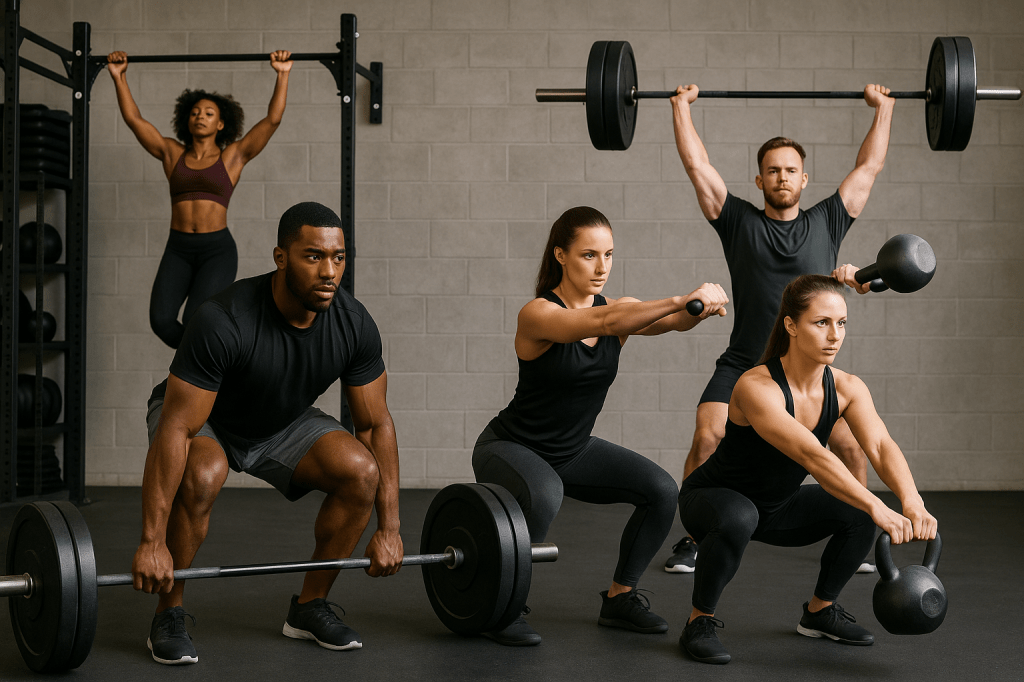
When it comes to building muscle and enhancing athletic performance, compound exercises are the cornerstone of effective strength training. Unlike isolation moves that target a single muscle, compound exercises engage multiple muscle groups simultaneously, making them a time-efficient and powerful way for athletes to increase strength, improve fitness, and reduce injury risk.

Why Compound Exercises Matter for Athletes

Athletes rely on functional strength — the ability to perform movements that mimic real-world activities or their specific sport. Compound exercises perfectly align with this goal because they replicate multi-joint motions, promote muscle coordination, and boost overall power.

By incorporating compound lifts into your training routine, you stimulate greater muscle activation, leading to improved muscle growth and strength gains. Additionally, these exercises enhance core stability and joint health, essential for athletic longevity.

Top Compound Exercises for Muscle Building and Athletic Fitness

Here are some foundational compound exercises every athlete should consider, along with step-by-step instructions to perform them safely and effectively:

  1. Squats

Targets: Quadriceps, hamstrings, glutes, core, and stabilizing muscles.

How to Perform a Squat:

Place your feet roughly between hip and shoulder width, allowing your toes to angle outward slightly.

Engage your core and keep your chest up.

Gradually lower yourself by bending at the hips and knees, as though you’re lowering into a seated position.

Lower yourself until your thighs are roughly parallel to the floor, or as far as your flexibility comfortably permits.

Drive upward by pressing firmly through your heels to rise back to the starting stance.

Make sure your knees stay aligned with your toes during the entire motion.

  1. Deadlifts

Targets: Hamstrings, glutes, lower back, traps, and grip.

How to Perform a Deadlift:

Set your feet about hip-width apart and position the barbell just in front of your shins.

Hinge at your hips and bend your knees to grasp the bar with hands just outside your knees.

Tighten your core muscles, maintain a straight back, and keep your chest upright.

Drive upward by pushing firmly through your heels, extending your hips and knees while keeping the barbell close to your body during the lift.

Once fully upright, begin lowering the bar by first hinging at your hips, followed by bending your knees in a controlled manner.

  1. Bench Press

Targets: Chest, shoulders, triceps.

How to Perform a Bench Press:

Position yourself flat on the bench with your feet planted solidly on the ground for stability.

Grip the bar with your hands placed slightly wider than shoulder distance.

Carefully lift the bar off the rack and begin lowering it in a controlled motion toward the center of your chest.

As you lower the bar, keep your elbows angled roughly 45 degrees away from your body.

Press the bar upward until your arms are extended, keeping the motion steady and controlled.

Avoid snapping your elbows straight; instead, stop just short of full lockout to maintain muscle tension.

  1. Pull-Ups and Chin-Ups

Targets: Upper back, biceps, grip strength.

How to Perform a Pull-Up:

Grab the pull-up bar with your palms facing away for a pull-up or toward you for a chin-up, placing your hands roughly shoulder-width apart.

Hang with your arms fully extended.

Activate your upper back muscles and begin pulling yourself upward by bending your elbows, aiming to bring your chest close to the bar.

Perform the movement with control, avoiding any swinging or using momentum to assist.

Lower yourself down slowly and with control until your arms are fully extended.

Overhead Press
Muscle Groups Worked: Shoulders, triceps, upper chest.

How to Perform the Overhead Press:

Position your feet about shoulder-width apart and hold a barbell or dumbbells at shoulder level, keeping your palms facing forward.

Tighten your core muscles and maintain a neutral, straight spine throughout the movement.

Raise the weight above your head until your arms are fully extended.

Avoid arching your back; keep your ribs down and core tight.

Slowly lower the weight back to shoulder height.

Tips for Effective Strength Training with Compound Movements

Focus on Form First: Proper technique is critical. Begin with lighter loads to perfect your technique before increasing the weight.

Progressive Overload: Gradually increase weights or reps to continuously challenge muscles and stimulate growth.

Balanced Routine: Incorporate compound exercises targeting all major muscle groups to avoid imbalances and reduce injury risk.

Adequate Recovery: Strength training is intense; allow muscles time to repair and grow with rest days and proper nutrition.

The Benefits Beyond Muscle Growth

Compound exercises do more than build muscle. For athletes, they:

Enhance coordination and balance by requiring multiple muscles and joints to work together.

Improve cardiovascular fitness due to their demand on large muscle groups.

Support functional movement patterns, making athletic performance more efficient and powerful.

Reduce injury risk through strengthened muscles and improved joint stability.

Incorporating compound exercises into your strength training routine is a proven way to build muscle and elevate your athletic fitness. By focusing on these foundational movements and following smart training principles, you can unlock your full potential and enjoy the benefits of enhanced strength, performance, and overall wellness.

Categories
Baths exercises Fitness fitness-tips flexibility Gym home workout Meals men Muscle Gain nutrition recovery recovery & wellness strength training Supplements training women

Top Seniors Supplements for Muscle Growth

As we age, maintaining muscle mass becomes increasingly important—not just for strength, but for overall health, mobility, and quality of life. For seniors dedicated to fitness and wellness, nutrition and meal prep play a crucial role in supporting muscle growth and recovery. While a balanced diet is the foundation, certain supplements can provide targeted support to help seniors maintain and even build muscle effectively.

In this article, we’ll explore the top supplements seniors can consider to enhance muscle growth, alongside practical nutrition and meal prep tips tailored to their unique needs—with easy-to-follow instructions.

Why Muscle Growth Matters for Seniors

Muscle loss, or sarcopenia, naturally occurs as part of aging and can lead to weakness, falls, and reduced independence. But with the right combination of exercise, nutrition, and supplements, seniors can slow or even reverse this decline. Supplementing smartly supports recovery, increases muscle protein synthesis, and boosts overall fitness results.

Key Supplements for Seniors Focused on Muscle Growth (With How-To Use)

  1. Protein Powders (Whey, Casein, or Plant-Based)

Protein is vital for muscle growth and recovery.

Yet, many older adults find it difficult to get sufficient protein through their everyday meals.

Tips for adding protein supplements:

Aim to consume between 20 and 30 grams of protein at every meal to help preserve and grow muscle mass.

Consider adding a scoop of protein powder—typically providing around 20 to 25 grams of protein—into smoothies or mixing it with milk or water for convenience.

For best results, consume protein powder within an hour after completing strength training to aid muscle recovery.

If you choose casein protein, taking it before bed can provide a slow and steady release of amino acids during sleep.

Creatine Monohydrate
Creatine is known for its ability to restore energy stores in muscle cells, which helps enhance strength and speed up recovery times.

How to use creatine effectively:

Consume 3 to 5 grams each day, ideally after exercising, combined with water or juice to enhance absorption.

If using casein, take it before bedtime for slow release during sleep.

  1. Creatine Monohydrate

Creatine helps replenish energy in muscle cells, improving strength and recovery.

How to use:

Consume 3 to 5 grams of creatine each day, preferably following your workout, mixed with water or juice for optimal absorption.

There’s no need for a loading phase; consistent daily use is effective.

Drink plenty of water to stay hydrated while supplementing.

  1. Vitamin D

Vitamin D supports muscle function and bone health.

How to use:

Have your vitamin D levels assessed through a medical checkup with your healthcare provider.

Supplement with 1,000 to 2,000 IU daily, or as advised by a healthcare provider.

Take with a meal that contains fat for better absorption.

  1. Omega-3 Fatty Acids

Omega-3s aid muscle recovery and reduce inflammation.

How to use:

Consume a daily dose of 1,000 mg of EPA and DHA combined—be sure to verify the amounts on your supplement’s label.

Choose high-quality fish oil supplements with purity certification.

Consume with meals to improve digestion and absorption.

  1. Branched-Chain Amino Acids (BCAAs)

BCAAs stimulate muscle repair and reduce soreness.

How to use:

Consume 5 to 10 grams of BCAAs either just before or right after exercising.

Mix with water or your favorite beverage.

Use on rest days to aid recovery if needed.

Nutrition & Meal Prep Tips for Seniors Focused on Muscle Health (Step-by-Step)

Step 1: Prioritize Protein

Incorporate a quality protein source into each meal, such as chicken, fish, legumes, dairy, or protein supplements. Measure approximately 3 to 4 ounces of meat or one serving of protein powder using a kitchen scale or measuring tools.

Step 2: Balance Your Plate

Cover half of your plate with a variety of colorful vegetables, dedicate a quarter to lean proteins, and reserve the last quarter for whole grains or complex carbs.

Step 3: Meal Prep for Consistency

Spend one or two days a week preparing meals in bulk. Prepare lean protein dishes and roast a variety of vegetables, then divide the meals into individual containers. Store them in the refrigerator or freezer for convenient, ready-to-eat options throughout the week.

Step 4: Stay Hydrated

Aim for 6-8 glasses of water daily. Carry a reusable water bottle and sip throughout the day.

Step 5: Incorporate Strength Training

Engage in resistance exercises 2-3 times per week, focusing on major muscle groups. Consult a fitness professional for age-appropriate routines.

Final Thoughts

Building and maintaining muscle as a senior isn’t just about staying fit—it’s about preserving independence, boosting confidence, and improving quality of life. The right combination of nutrition, meal prep, fitness, and carefully chosen supplements can make a meaningful difference.

Important: Always consult your healthcare provider before starting new supplements to ensure they fit your health profile.

With thoughtful planning and dedication, seniors can continue to grow stronger and enjoy the benefits of an active lifestyle.

Categories
athletes cardio cardio & endurance exercises fat loss Fitness flexibility & mobility Gym yogis

Top Cardio Exercises for Yogis Lovers

If your usual go-to is a calming yoga flow, you might not think of cardio as a natural fit. But if you’re looking to improve stamina, boost heart health, or simply find more energy throughout your day, mixing cardio & endurance work into your wellness routine can deeply enhance your overall fitness.

This guide is designed for yogis who want to maintain their mind-body connection while exploring movement that elevates the heart rate in a sustainable, mindful way.

Why Should Yogis Add Cardio?

Yoga builds strength, balance, and flexibility—but it often lacks the sustained intensity needed to challenge your cardiovascular system. Adding 2–3 cardio sessions per week can:

Boost your endurance for long practices

Improve oxygen flow for breathwork (pranayama)

Enhance circulation and cardiovascular health

Help with detoxification through sweat

Balance a sedentary lifestyle if you sit often during the day

Best Cardio Exercises for Yogis (With Instructions)

These exercises are gentle on the joints, accessible for all levels, and easy to integrate into a yoga-friendly lifestyle.

  1. Walking or Hiking

Why it works: Low-impact, meditative, and great for stamina.

How to do it:

Aim for 30–45 minutes, 3–4 times per week.

Focus on maintaining an upright posture and relaxed breath.

If you walk after yoga, let your body stay in “flow mode” by moving mindfully, not briskly.

Try breath syncing: inhale for 4 steps, exhale for 4 steps.

Tip: Nature walks offer grounding benefits—perfect for yogis who practice mindfulness or meditation.

  1. Jump Rope

Why it works: Builds coordination and raises your heart rate quickly.

How to do it:

How to Get Started with Jump Rope:

Begin with short bursts—jump for about 30 seconds, then take a 30-second break.

Complete 5 cycles to keep the session around 5 minutes.

Keep your elbows tucked in and aim for quick, light jumps—think of it more like bouncing than leaping.

Focus on soft landings to ease pressure on your joints; imagine you’re skipping quietly on a yoga mat.

Pro tip: Use jump rope as a warm-up before a vinyasa session to get your blood flowing and loosen up tight muscles.

  1. Swimming

Why it works: Full-body, low-impact, and breath-focused.

How to do it:

Swim laps for 20–30 minutes, mixing strokes (freestyle, breaststroke).

Focus on steady, rhythmic breathing—inhale through the mouth, exhale through the nose if possible.

Alternate your pace—swim two laps at a relaxed speed, then follow with one lap at a more vigorous effort.

Tip: Swimming pairs beautifully with yoga’s emphasis on breath control and fluid motion.

  1. Dance or Free Movement

Why it works: Cardio disguised as joy. Great for creativity and emotional release.

How to do it:

Put on your favorite playlist.

Set a timer for 10–20 minutes.

Move freely—there’s no “right” way.

Let your breath and body lead. Don’t think; just move.

Tip: Follow up with a short yin yoga sequence to integrate and settle your energy.

  1. Bodyweight Intervals (Yoga + HIIT Hybrid)

Why it works: Increases heart rate while using functional movement that supports yoga poses.

How to do it:

Perform the following as a 10-minute circuit, 2–3 rounds:

Exercise Duration Instruction
Jumping Jacks 30 seconds Keep shoulders relaxed, land lightly

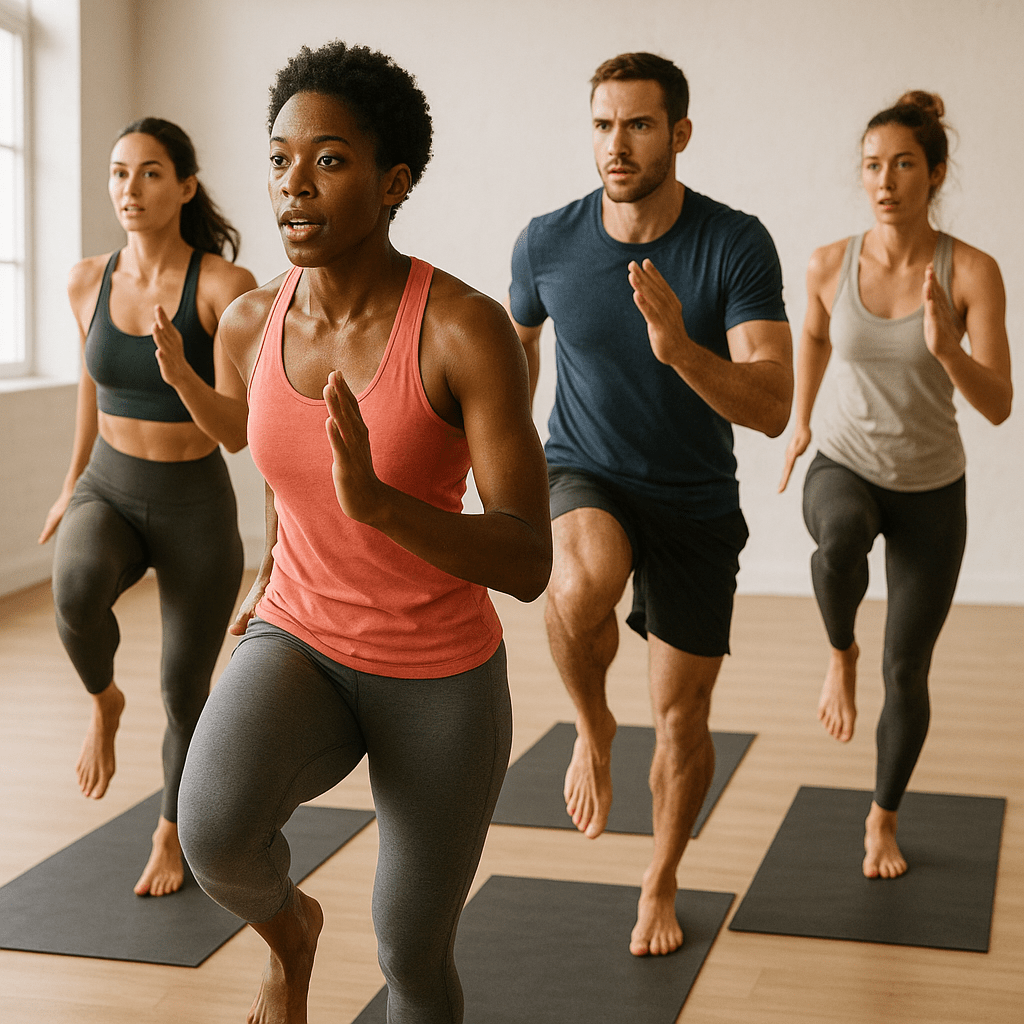
High Knees 30 seconds Bring knees to hip height, engage your core

Mountain Climbers 30 seconds Keep a strong plank shape, drive knees forward

Rest 30 seconds Breathe deeply and reset posture

Chair Pose Pulses 30 seconds From utkatasana, pulse 2–3 inches up/down slowly

Plank to Down Dog 30 seconds Flow between poses for breath and shoulder mobility

Suggestion: Wrap up your session with a calming pose like savasana or a gentle reclining twist to help your body unwind.

How to Combine Cardio & Yoga

Below is a practical example of how you can organize your weekly schedule:

Day AM PM

Monday Light walk (30 min) Yin Yoga (20–30 min)

Tuesday Vinyasa Yoga (45 min) –

Wednesday Swimming (20–30 min) Gentle stretching

Thursday HIIT-style circuit (20 min) Meditation (10 min)

Friday Rest or easy hike Restorative Yoga

Saturday Free dance (15 min) Flow Yoga

Sunday Long walk or rest Journaling + breathwork

Final Thoughts
Cardio & endurance exercises don’t compete with your yoga—they complement it. When done mindfully, they boost energy, deepen awareness, and improve your resilience both on and off the mat. Start small, listen to your body, and let your practice evolve to support your full fitness potential.

Categories
exercises Fitness flexibility flexibility & mobility mobility stretching

Dynamic vs. Static Stretching: What’s Best for Flexibility?

When it comes to improving flexibility & mobility, understanding the difference between dynamic and static stretching can be a game-changer for your fitness routine. Both types of stretching serve important roles, but knowing when and how to use them can maximize your performance, prevent injuries, and enhance your overall flexibility.

What is Dynamic Stretching?
Dynamic stretching is all about moving your body in a smooth, controlled way that wakes up your muscles and gets them ready to move freely. Imagine things like leg swings, arm circles, or walking lunges — simple moves that get your blood pumping and muscles warmed up before you dive into your workout or any physical activity.

How to Do Dynamic Stretching:
Leg Swings: Find a wall or something sturdy to hold onto. Swing one leg forward and backward in a relaxed rhythm, gradually lifting it higher as you go. Aim for about 10 to 15 swings per leg.

Arm Circles: Stretch your arms out to the sides and start making circles — first small, then bigger — moving forward for about 20 seconds, then switch to backward circles for the same amount of time.

Walking Lunges:
Step forward like you mean it, then sink down into a lunge so your back knee hovers just above the floor. Push through your front heel to stand up and step into the next lunge with the opposite leg. Keep that rhythm going for 10 to 12 lunges per side — think of it as a walking stretch with bonus strength work.

This kind of movement gets your muscles loose, your joints moving smoothly, and your body ready to crush whatever workout you’ve got planned.

Benefits of Dynamic Stretching for Flexibility:
Improves mobility by preparing joints for movement

Enhances muscle activation and coordination

Reduces muscle stiffness and risk of injury

Boosts overall performance in sports and fitness

What’s Static Stretching, Anyway?

Static stretching is the chill side of flexibility work. It’s basically hitting pause and sinking into a stretch, holding it still for about 20 to 60 seconds. This gives your muscles and tendons time to gently open up and let go of tension. Think of it as your body’s way of exhaling after a workout — the calm, feel-good moment where tight spots get some much-needed attention and your flexibility gets a little boost.

How to Do Static Stretching (Without Overthinking It):

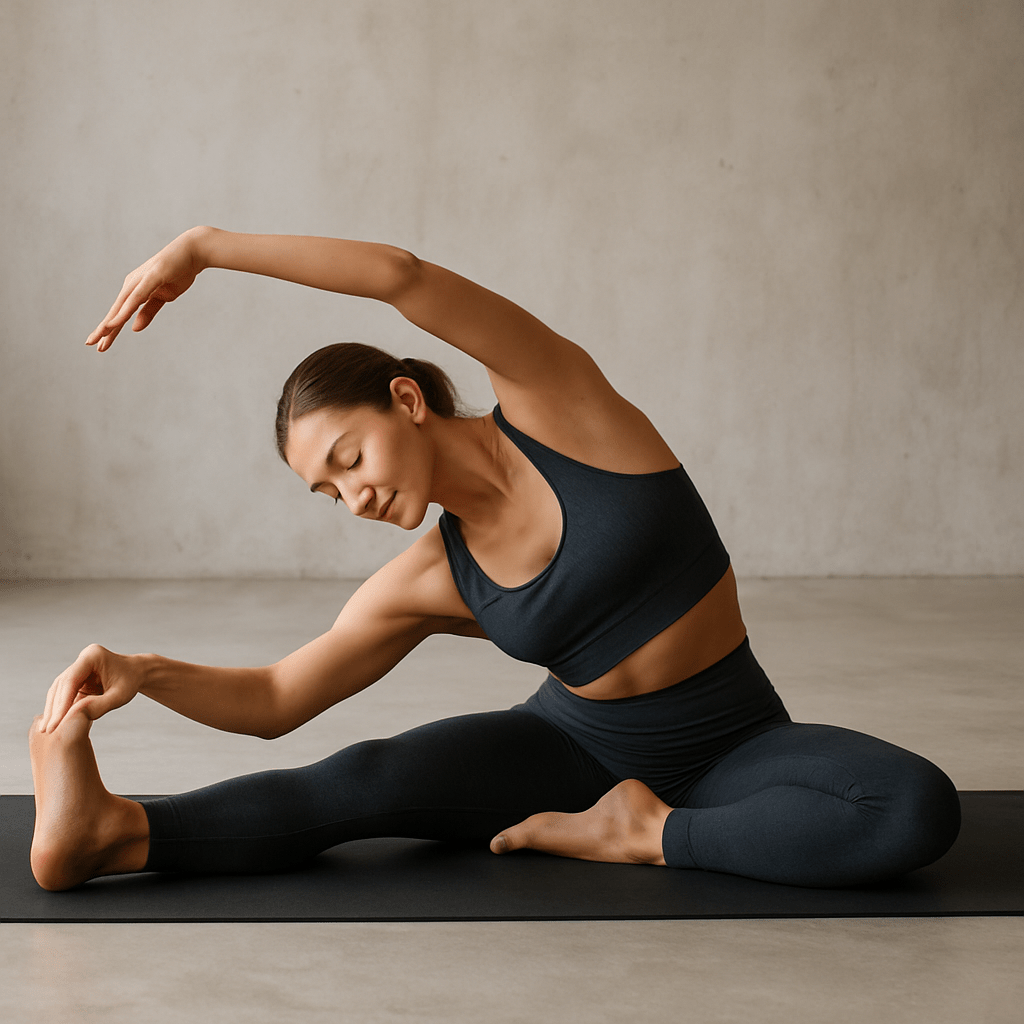
Seated Hamstring Reach:

Find a comfy spot on the floor. Stretch one leg out in front of you and fold the other so the sole of your foot rests near your opposite thigh. Lean gently toward your extended foot — no need to yank yourself forward — and hold for about 30 seconds. Then switch sides and repeat. Breathe deeply and let gravity help you out.

Chest Opener in a Doorway:

Stand in a doorway and place your forearms or hands on either side of the frame, elbows bent. Take a small step forward and let the stretch open up across your chest and shoulders — you’ll feel it kick in as you ease into it. Hold for 20 to 30 seconds while keeping your posture relaxed.

Standing Quad Stretch:

Stand up tall and balance on one leg. Bend the other knee, bringing your heel up toward your butt. Grab your ankle with your hand and hold the stretch through the front of your thigh. Hang out in the stretch for about 20 to 30 seconds, then switch it up and do the other leg. Tip: if you’re feeling a bit wobbly, grab a wall or chair for support — no shame in staying steady!

Static stretching is a great way to wrap up your workout or simply give your body some love on a rest day. It’s all about slowing down, tuning in, and giving your muscles time to breathe and recover.

Benefits of Static Stretching for Flexibility:
Increases muscle length and joint range of motion over time

Helps cool down muscles and aids recovery

Promotes relaxation and reduces muscle tension

Supports long-term flexibility gains when practiced consistently

Which One Should You Choose?

The simple answer: both! But timing and purpose matter.

Before your workout or physical activity, dynamic stretching is your best bet. It preps your body by increasing mobility and circulation, which can enhance performance and reduce injury risk.

After your workout or during dedicated flexibility sessions, static stretching helps elongate muscles and improve flexibility in a calm, controlled way.

For anyone serious about fitness, incorporating both dynamic and static stretching will build a solid foundation for mobility and flexibility that supports your goals.

Tips for Maximizing Flexibility & Mobility

Warm up with dynamic stretches tailored to your activity.

Use static stretches to target tight or overworked muscles post-exercise.

Be consistent—flexibility improves gradually over time.

Pay attention to what your body’s telling you — stretching shouldn’t feel like a battle. If it hurts, ease up. Discomfort is okay; pain is your cue to back off.

Combine stretching with strength training for balanced fitness.

Final Thoughts

Flexibility and mobility aren’t just extras — they’re just as important as lifting weights or doing cardio. Mixing in the right balance of dynamic and static stretching can seriously improve how you move, help you steer clear of injuries, and just make your body feel better overall.

Take the time to understand what your body needs at each moment—dynamic stretches to wake it up, static stretches to calm and lengthen it. Your muscles will thank you, and your fitness journey will become more enjoyable and sustainable.

Categories
athletes exercises home workout men Muscle Gain recovery & wellness strength training training Uncategorized yogis

Full Body Strength Workout with Yogis

For yogis, strength training can be a powerful complement to a regular yoga practice. While yoga develops flexibility, balance, and breath awareness, strength training enhances muscle support, stability, and joint health. When these practices are combined, they build a more functional, injury-resistant, and balanced body.

Why Strength Training Benefits Yogis
Many yogis assume strength training might “bulk them up” or reduce flexibility, but the truth is the opposite. Mindful resistance work helps deepen poses, stabilize transitions, and prevent injury by reinforcing the muscles that support joints. Strength doesn’t interfere with yoga—it enhances it.

Full Body Strength Workout for Yogis
No machines or barbells required. Just your bodyweight, a pair of light-to-medium dumbbells, and optional resistance bands. Here’s a yogi-friendly routine to target all major muscle groups.

  1. Chair Pose to Overhead Press
    Muscles: Quads, glutes, shoulders
    Equipment: Dumbbells (optional)

Instructions:

Plant your feet about hip-width apart and bring the dumbbells up to shoulder level, keeping your elbows bent and close to your body.

Inhale as you sink into Chair Pose (Utkatasana), keeping weight in your heels.

Let the air out as you press the weights overhead, rising up tall with a straight, strong posture.

If you want it more poetic or more direct, just say the word!

Lower weights back to shoulders and repeat.

Reps: 3 sets of 10

  1. Plank Rows (Renegade Rows)
    Targets: Core, back, arms
    Gear: Dumbbells

Get into a solid high plank position, gripping the dumbbells just beneath your shoulders, and keep your whole body in a straight line from head to heels.

Engage your core and shift weight slightly to the left.

Row the right dumbbell toward your rib cage, elbow close to body.

Lower it with control and repeat on the other side.

Reps: 3 sets of 8 per side

  1. Glute Bridges
    Muscles: Glutes, hamstrings, lower back
    Equipment: Bodyweight or resistance band

Instructions:

Lie on your back with knees bent, feet flat and hip-width apart.

Arms down by your sides, palms facing the mat.

Inhale, then exhale as you press through your heels to lift hips.

Squeeze your glutes at the top, hold for a breath, then lower slowly.

Reps: 3 sets of 15

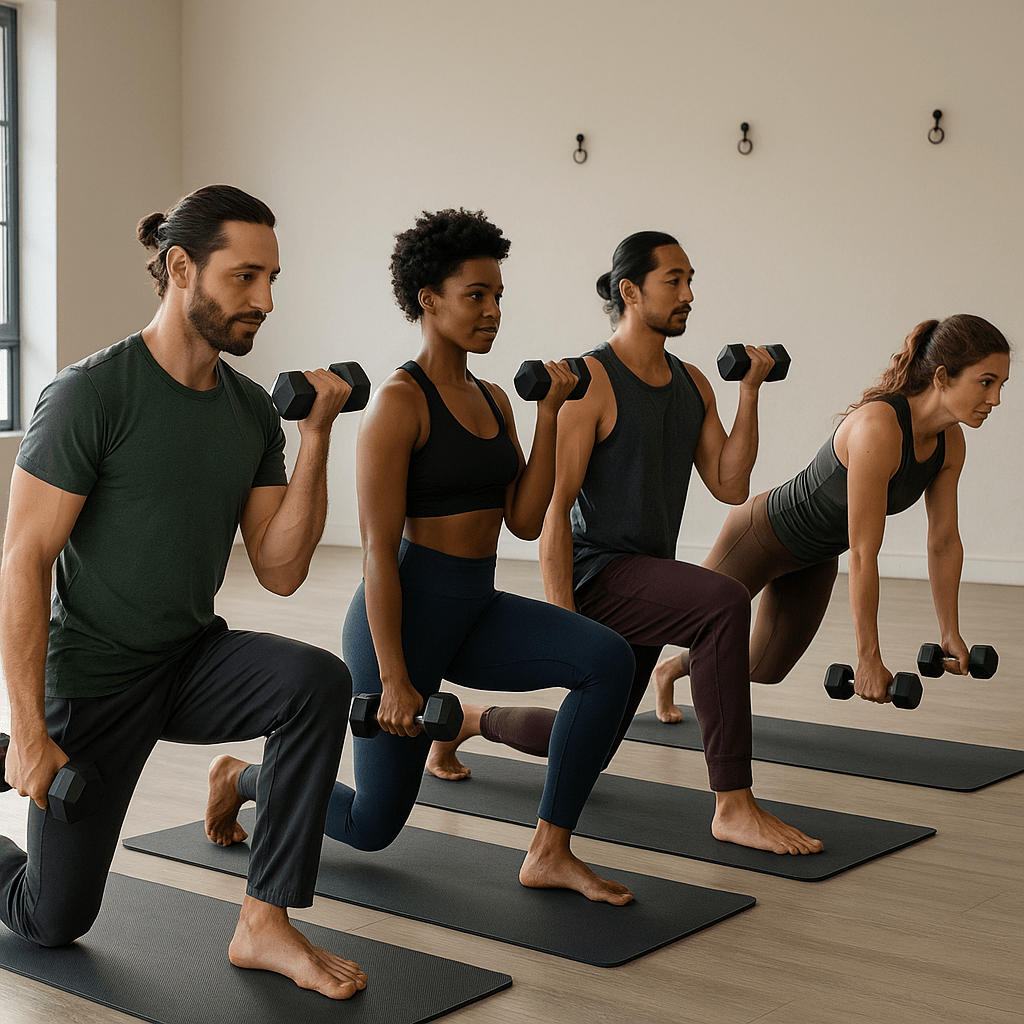
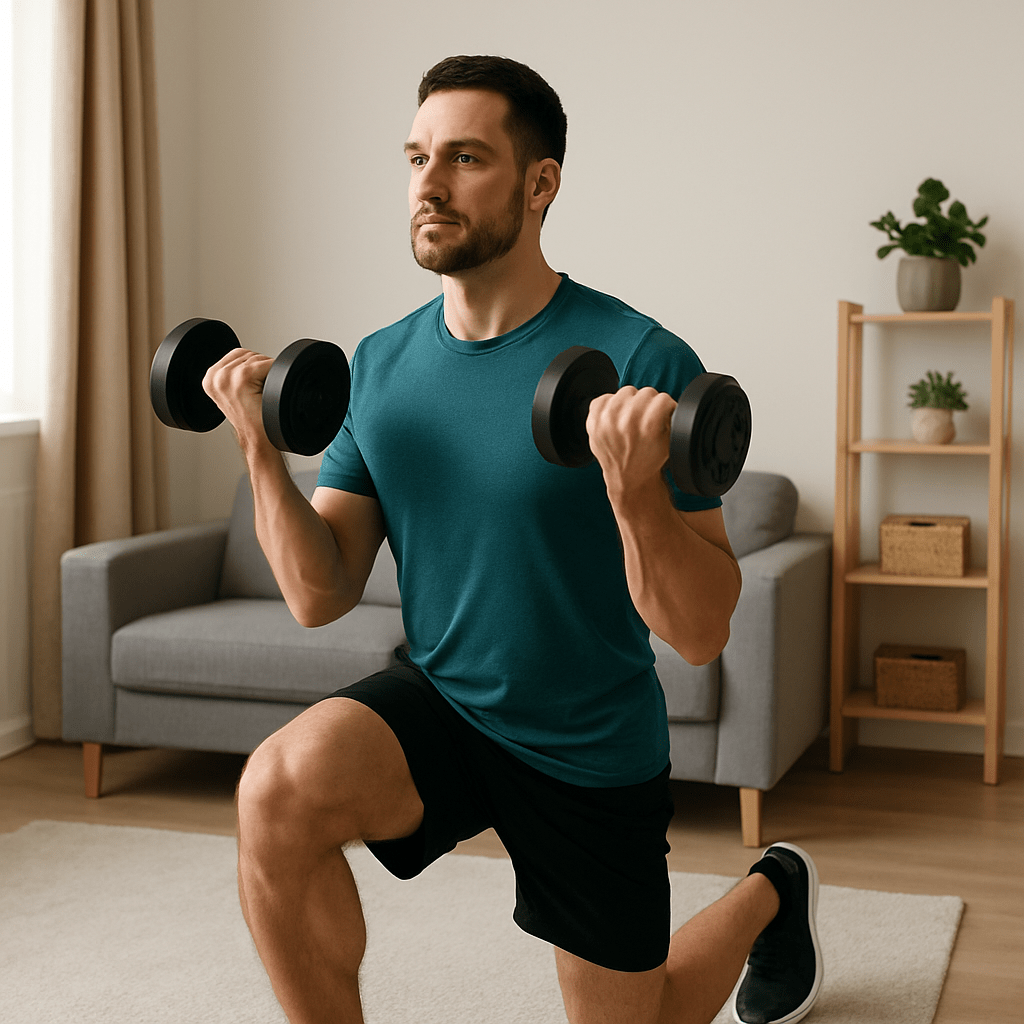
  1. Crescent Lunge with Bicep Curl
    Muscles: Legs, glutes, biceps, core
    Equipment: Dumbbells

Instructions:

Step the right foot forward into a deep lunge, back heel lifted.

Hold dumbbells at your sides, elbows close.

As you lower into the lunge, bring those weights up with a smooth curl.

Lower weights and switch sides after each set.

Reps: 3 sets of 10 per side

  1. Wall Sit Hold
    Muscles: Quads, glutes, calves
    Equipment: Wall

Instructions:

Position yourself with your back flat against a wall and step your feet forward about two feet, keeping them hip-width apart.

Slide gently down the wall until your thighs are parallel to the floor, like you’re sitting in an invisible chair, with your knees bent around a right angle.

Keep knees over ankles, core tight, and back flat.

Maintain the pose, keeping your hands free and off your legs for support.

Hold: 3 sets of 30 seconds

Tips for Integration into a Yoga Practice
Begin with breath: Approach each movement as a mindful flow, not a task.

Do this 1–2x per week: You don’t need daily lifting to see results.

Use yoga as recovery: Incorporate restorative flows on rest days.

Listen to your body: Just like yoga, strength work requires self-awareness.

Final Thoughts
When yogis begin strength training with intention and body awareness, it becomes an extension of their practice—not a disruption. Strength brings stability into postures, endurance into sequences, and resilience into daily life. Fitness doesn’t have to be a competition; it can be an exploration. With the right balance, your mat becomes both a place of flexibility and power.

Categories
exercises Fitness men Muscle Gain strength training

Build Muscle with These Muscle Gain Compound Exercises

Building muscle isn’t just about lifting heavy—it’s about lifting smart. If you’re looking to increase muscle mass, improve overall fitness, and build lasting strength, compound exercises should be at the core of your workout routine.

These multi-joint movements engage multiple muscle groups at once, making them highly efficient for muscle gain and strength training. Whether you’re just starting out or looking to refine your program, here’s a guide to the best compound exercises and how to perform them correctly for maximum results.

Why Compound Exercises?
Compound exercises trigger greater hormonal responses (like testosterone and growth hormone), which are essential for hypertrophy (muscle growth). They also mirror natural body movements, promoting functional strength and minimizing imbalances.

Benefits:

Recruit more muscle fibers per lift

Improve coordination and balance

Burn more calories per session

Enhance total-body strength and fitness

Top Compound Exercises for Muscle Gain with Instructions
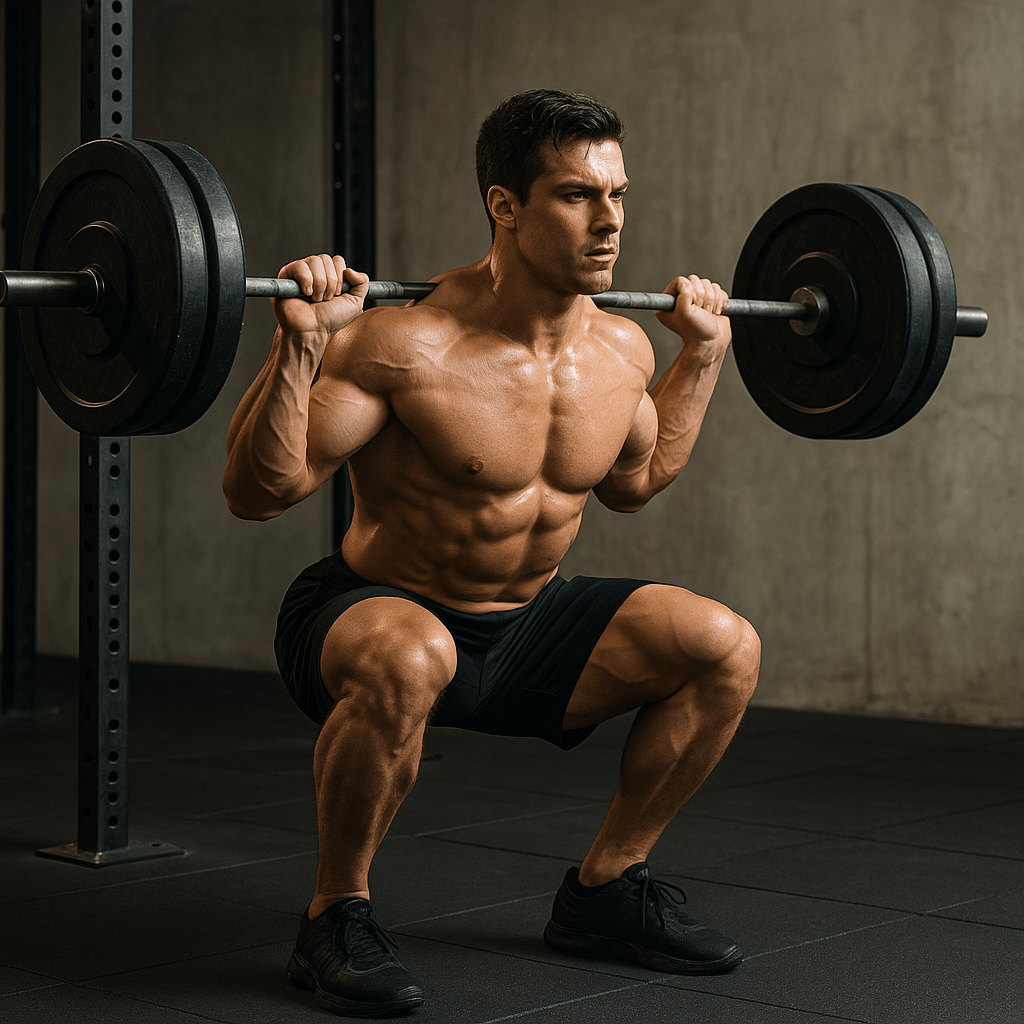
Squats
Muscles Worked: Quads, glutes, hamstrings, core
How to Do It:

Stand with feet shoulder-width apart.

Keep your chest up and spine neutral.

Shift your hips backward like you’re about to take a seat, while simultaneously bending your knees.

Descend until your thighs are roughly level with the ground—or go as low as feels natural for you.

Drive through your heels to stand back up.

Tips: Keep your knees tracking over your toes, avoid letting them collapse inward, and maintain core engagement throughout.

Deadlifts
Muscles Worked: Glutes, hamstrings, lower back, traps
How to Do It:

Stand with feet hip-width apart, barbell over mid-foot.

Hinge forward at the hips and bend your knees to grasp the barbell slightly outside your feet.

Maintain a neutral spine and lift your chest to keep your posture strong.

Tighten your core, then raise the bar by driving your hips and knees upward at the same time.

Maintain the barbell in close contact with your legs as you lift.

Bring the bar down slowly and with control to return to the starting position.

Tips: Keep your spine neutral, draw your shoulders back and down, and initiate the lift smoothly—avoid any sudden or jerky movements.

Bench Press
Muscles Worked: Chest, shoulders, triceps
How to Do It:

Lie flat on a bench, feet planted firmly on the floor.

Grip the bar slightly wider than shoulder-width.

Lower the bar slowly to your mid-chest.

Press the bar straight overhead until your arms lock out completely.

Tips: Retract your shoulder blades throughout the movement, resist letting the bar bounce off your chest, and focus on smooth, controlled motion.

Pull-Ups/Chin-Ups
Target Muscles: Lats, biceps, shoulders
How to Perform:

Grasp the pull-up bar using either an overhand grip for pull-ups or an underhand grip for chin-ups, positioning your hands just beyond shoulder width.

Hang fully extended with shoulders engaged.

Lift your body until your chin rises above the bar.

Lower yourself smoothly and deliberately until your arms are fully extended in the starting position.

Tips: Steer clear of swinging or using momentum; if necessary, incorporate resistance bands or assisted devices to help develop your strength.

Overhead Press (Standing)
Muscles Targeted: Shoulders, triceps, upper chest, core
How to Perform:

Position yourself with feet shoulder-width apart, holding the barbell at shoulder level.

Brace your core and glutes for stability.

Press the bar straight overhead until arms are fully extended.

Lower the bar back down under control.

Tips: Avoid arching your lower back, keep your head neutral, and engage your core throughout.

Barbell Rows
Muscles Worked: Lats, rhomboids, traps, biceps
How to Do It:

Stand with feet shoulder-width apart, hinge forward at the hips.

Hold the barbell with an overhand grip, arms extended.

Pull the barbell towards your lower chest/upper abdomen.

Lower it back down with control.

Tips: Maintain a straight back and engage your core throughout the movement, avoid swinging or jerking the weight, and keep your elbows tucked close to your sides.

General Guidelines for Safe and Effective Training
Warm-Up: Begin each session with 5 to 10 minutes of light cardio combined with dynamic stretches to activate your muscles and loosen your joints.

Start Light: Focus on mastering your form using lighter weights or just the bar before gradually adding more resistance.

Controlled Execution: Perform every repetition deliberately and steadily, steering clear of using momentum to complete the lift.

Breathing Technique: Breathe in as you lower the weight (eccentric phase) and exhale as you push or lift the weight (concentric phase).

Rest: Between sets, rest 60–90 seconds for hypertrophy focus; longer rest (2–3 mins) for maximal strength.

Progress Gradually: Increase weights or reps only when your form is perfect to avoid injury.

Recovery: Allow 48 hours between sessions targeting the same muscle groups for optimal recovery and growth.

Techniques for Effective Muscle Gain
Gradually challenge your muscles by steadily increasing the weight, number of repetitions, or workout intensity as you advance.

Perfect Form: Always prioritize technique over ego lifting.

Rest and Recovery: Muscles grow during rest—don’t skip sleep or recovery days.

Consistency: A long-term plan beats occasional bursts of hard training.

Nutrition Matters: Pair training with high-protein meals and smart carbs to fuel muscle growth.

Sample Weekly Routine (Push/Pull/Legs)
Day 1 – Push (Chest/Shoulders/Triceps)

Bench Press – 4×6

Overhead Press – 3×8

Dips – 3×10

Day 2 – Pull (Back/Biceps)

Deadlifts – 4×5

Pull-Ups – 3xAMRAP

Barbell Rows – 3×8

Day 3 – Legs/Core

Squats – 4×6

Romanian Deadlifts – 3×10

Plank – 3×1 min

Closing Thoughts
Building muscle through strength training doesn’t have to be complex—it requires dedication and a well-designed strategy. Compound movements form the foundation of any successful workout routine, helping you gain muscle efficiently while developing balanced, practical strength.

By integrating these compound lifts into your training, following the instructions closely, and focusing on recovery and nutrition, you’ll see impressive results. Stronger muscles, better fitness, and more confidence await.

Categories
athletes cardio exercises fat loss Fitness HIIT runners

HIIT Routine to Burn Fat in Runners Minutes

For runners who want to burn fat more efficiently and build cardio & endurance without doubling their training time, HIIT (High-Intensity Interval Training) is a game changer. In just 20 minutes or less, you can spike your metabolism, improve performance, and stay lean — no extra miles required.

What Makes HIIT So Effective for Runners?
HIIT alternates short bursts of intense activity with recovery periods, maximizing your heart rate and oxygen consumption. This not only helps burn fat during the workout but also continues to torch calories for hours afterward thanks to the afterburn effect (EPOC – Excess Post-exercise Oxygen Consumption).

For runners, this means a faster metabolism, stronger cardiovascular health, and improved endurance — all packed into less time than your usual long run.

Step-by-Step: HIIT Routine for Runners (Total Time: ~20 minutes)
You don’t need fancy equipment — just a stopwatch, some open space, and your running shoes.

Step 1: Warm-Up (5 Minutes)
Start with light movement to prepare your muscles and joints.

Instructions:

Jog at an easy pace for 3 minutes

Then do 2 minutes of dynamic stretches:

10 leg swings (each leg)

20 high knees

20 butt kicks

10 bodyweight squats

This helps increase blood flow and prevent injury.

Step 2: HIIT Main Set (12 Minutes)
You’ll alternate between sprinting and recovery. One round takes 2 minutes. Complete 4 total rounds.

Instructions (per round):

Sprint at 80–90% effort for 40 seconds

Walk or jog slowly for 1 minute 20 seconds

Tip:
You should feel winded by the end of each sprint but be able to recover enough to go again. Adjust intensity based on your fitness level.

Step 3: Cool-Down (3 Minutes)
Ease your body back to baseline and promote recovery.

Instructions:

Jog or walk at a very light pace for 2 minutes

End with 1 minute of deep breathing and static stretching

Focus on hamstrings, calves, quads, and hip flexors

Pro Tips for Better Results
Do this 2–3x per week on non-consecutive days for best results.

Hydrate and fuel properly post-workout — aim for protein + complex carbs.

Track progress using a fitness app or running watch.

Modify intensity based on goals (e.g., use hills for more resistance).

Benefits Beyond Fat Loss
Incorporating HIIT into your running routine helps you:

Boost overall cardio & endurance

Improve speed and power

Build mental resilience for race day

Burn fat more efficiently — even at rest

Final Thoughts
This HIIT routine isn’t just about cutting fat — it’s about training smarter. Runners who balance distance runs with short, powerful intervals often perform better, stay injury-free, and enjoy their workouts more.

So the next time you lace up, skip the long grind. Try this HIIT session and feel the difference — in both your pace and your physique.

Categories
exercises home workout Muscle Gain strength training

Build Muscle with These Home Workouts Compound Exercises

In the hustle of modern life, carving out time for the gym isn’t always realistic—and for many, it’s not even appealing. The upside? You can still build muscle and elevate your fitness without stepping foot in a gym or investing in bulky machines. With smart, compound exercises, effective strength training is completely achievable right in your living room.

Let’s dive into the most effective home workouts for building muscle, and how to do them safely and effectively.

What Are Compound Exercises?
Compound exercises work several muscle groups at the same time, making them far more efficient than isolation movements like bicep curls. Rather than focusing on just one area, these exercises activate multiple parts of your body in a single motion. The result?

Increased muscle activation

Greater calorie burn

Improved functional strength

More efficient workouts

When it comes to working out at home, compound exercises are incredibly effective. They offer the best return on effort—delivering big results without the need for much gear or a lot of time.

Best Compound Moves to Build Strength at Home
These are some of the most effective bodyweight and low-equipment exercises you can begin incorporating into your routine right now:

  1. Push-Ups
    Target Areas: Chest, shoulders, triceps, and core
    Form Pointer: Keep your elbows angled about 45 degrees from your body and engage your core throughout the movement to ensure stability and proper technique.
  2. Squats
    Works: Quads, hamstrings, glutes, and lower back
    Push Your Limits: Incorporate a jump at the top of the movement to elevate intensity and enhance your power output.
  3. Lunges
    Target Muscles: Glutes, quads, hamstrings, and core
    Technique Tip: Step forward with control, making sure your front knee stays in line with your ankle. This helps improve balance, protects your joints, and ensures proper form throughout the movement.
  4. Plank-to-Push-Up
    Targets: Core, chest, shoulders
    Benefit: Improves stability and upper-body strength simultaneously.
  5. Burpees
    Muscle Groups Engaged: Whole body
    Note: These exercises are demanding, but the benefits for building strength and improving conditioning make them absolutely worthwhile.
  6. Pull-Ups or Resistance Band Rows
    Targets: Back, arms, shoulders
    Equipment: Use a doorway pull-up bar or a resistance band looped around a stable surface.

Techniques to Maximize Gains
Progressive Overload: Add reps, sets, or intensity each week.

Form First: Always prioritize proper technique over speed or volume.

Consistent Schedule: Aim for 3–4 strength training sessions per week.

Recovery Matters: Rest, hydrate, and fuel your body properly.

Benefits of Strength Training at Home
Flexibility: Train anytime, without travel or wait times.

Cost-Effective: No gym fees or expensive equipment needed.

Privacy: No pressure, no comparisons—just your goals.

Sustainable: Easier to stick with long term.