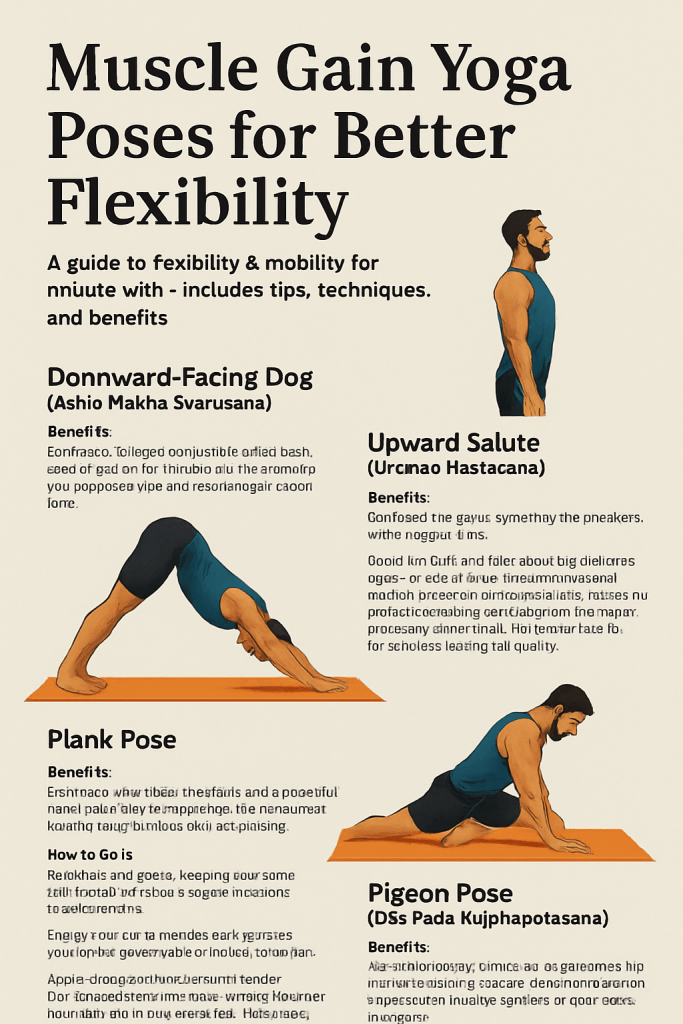
Muscle gain isn’t just about lifting heavy or eating big—it’s also about how well your body moves. Incorporating yoga into your routine can significantly boost flexibility & mobility, which directly supports muscle development, recovery, and injury prevention.
This guide explores key yoga poses that improve flexibility while activating and supporting muscle growth. Each pose includes step-by-step instructions to help you practice safely and effectively.
Why Flexibility & Mobility Matter for Muscle Gain
Improved mobility means your muscles can move through a full range of motion, allowing for more efficient lifts and reduced injury risk. Tight, immobile joints lead to compensation, overuse, and plateaus in your fitness journey. Yoga helps by:
Increasing blood flow to muscles
Enhancing joint stability and alignment
Supporting recovery through active stretching
Enhancing movement quality so your muscles fire efficiently and safely under load.
Yoga Poses for Muscle Gain & Flexibility
Below are six beginner-to-intermediate poses, each selected to target areas crucial for strength training.
- Downward-Facing Dog (Adho Mukha Svanasana)
This full-body stretch targets the entire back side of the body—from calves and hamstrings up through the spine—while also building strength in the shoulders, arms, and core. It’s a great pose for releasing tension and boosting circulation after a tough workout.
How to Do It:
Place your hands shoulder-width apart on the mat, with knees directly under your hips to establish a neutral stance.
Tuck your toes, lift your knees, and raise your hips toward the ceiling.
Work on straightening your legs gently, avoiding hyperextension of the knees.
Press your hands into the mat, keeping your spine long.
Maintain deep, steady breathing as you remain in the position for 30 to 60 seconds, allowing your muscles to ease and lengthen.
- Chair Pose (Utkatasana)
Benefits:
Activates quads, glutes, and back muscles while improving balance and core strength.
How to Do It:
Stand tall with feet together.
On your inhale, stretch both arms overhead, palms gently turned inward in a neutral position.
Exhale as you bend your knees, lowering your hips like sitting in a chair.
Focus on keeping your torso upright as you shift your weight toward your heels.
Hold for 30–60 seconds, then rise back up slowly.
- Low Lunge (Anjaneyasana)
Benefits:
Stretches tight hip flexors and strengthens legs—critical for squat depth and stride mobility.
How to Do It:
Step your right foot forward into a lunge, left knee down on the mat.
Ensure the right knee is directly above the ankle.
Raise both arms overhead and lift your chest.
Press your hips gently forward while keeping your back straight.
Hold for 30–45 seconds per side.
- Plank Pose
Benefits:
Develops strong, stable shoulders and a powerful core, while sharpening mental concentration—key elements for effective heavy lifting.
How to Perform:
Begin in a high plank position, with your arms straight and wrists aligned right under your shoulders.
Engage your core muscles and squeeze your glutes to maintain a strong, straight line from head to heels.
Avoid letting your hips dip or rise too high—aim for alignment.
Hold this position for 30 to 60 seconds, breathing evenly and with control.
- Pigeon Pose (Eka Pada Rajakapotasana)
Benefits:
This pose deeply stretches the glutes and hip rotators, helping to ease tension and improve lower-body mobility—perfect for post-training recovery.
How to Do It:
From Tabletop or Downward-Facing Dog, bring your right knee forward so it lands behind your right wrist.
Gently slide your right foot over toward your left wrist, allowing the shin to rest at an angle.
Extend your left leg straight behind you, keeping your toes pointing back.
Make sure your hips stay level—if they tilt, place a block under your right hip for support.
Gently lean forward, allowing your forearms to support you or letting your forehead rest softly on the mat.
Stay in the stretch for 1 to 2 minutes on each side, breathing deeply and allowing your body to release.
- Bridge Pose (Setu Bandha Sarvangasana)
Benefits:
It builds strength in the glutes and hamstrings, expands the chest, and enhances the mobility of the spine.
How to Do It:
Lie comfortably on your back, knees bent, and feet placed about hip-width apart.
Allow your arms to relax by your sides, palms resting softly on the mat with your shoulders grounded.
Push firmly through your heels to elevate your hips, using your glutes for a controlled, fluid movement.
Hold the pose for several breaths, then slowly lower down.
Hold for 1–2 minutes per side.
- Bridge Pose (Setu Bandha Sarvangasana)
Benefits:
This pose activates and strengthens the glutes and hamstrings, lifts and opens the chest, and promotes greater flexibility and extension through the spine.
How to Do It:
Start by lying flat on your back, knees bent, and feet planted on the floor roughly hip-distance apart.
Allow your arms to lie gently along your torso, pressing your palms lightly into the ground.
Anchor your feet firmly and lift your hips upward in a smooth, controlled motion toward the ceiling.
Squeeze your glutes and engage your core.
Hold for 30–45 seconds, then lower down slowly.
How to Add Yoga to Your Fitness Plan
Beginner’s Strategy:
Frequency: 2–3 times per week
Duration: 10–15 minutes post-workout or on rest days
Tip: Use yoga as active recovery—don’t push into pain, and focus on breath
Advanced Tip: Combine yoga with resistance band work or bodyweight drills to activate stabilizers and improve mind-muscle connection.
Final Thoughts
Rather than replacing weightlifting, yoga serves as a potent ally in your fitness journey.
Incorporating flexibility & mobility work into your routine can unlock deeper strength, faster recovery, and long-term muscle gain.
Whether you’re an experienced lifter or just starting your fitness journey, give these poses a try. Your body—and your gains—will thank you.
 Fitness Guide