Whether you’re just starting your fitness journey or you’re a seasoned athlete, you’ve probably heard conflicting advice about stretching. Should you go for slow, deep holds—or quick, active moves? The truth is, both dynamic and static stretching play important roles in supporting flexibility & mobility, especially for women navigating unique fitness goals, body changes, and energy demands.
Let’s clear up the confusion, and help you build a stretch routine that works with your body, not against it.
Dynamic Stretching: Best Before Workouts
What it is:
Dynamic stretching involves purposeful, movement-driven exercises that guide your joints through their entire range of motion in a smooth, controlled way.
It boosts circulation, wakes up your muscles, and gets your body physically and neurologically ready to perform.
Why it’s great for women:
It improves mobility, wakes up underused muscles, and supports balance—especially important for women dealing with tight hips, pelvic floor imbalances, or postural shifts.
Try This 5-Minute Dynamic Warm-Up (Before Workouts)
Leg Swings (30 sec/leg)
Stand tall, swing one leg forward and back. Keep your core engaged.
Arm Circles (30 sec)
Begin with small, steady circles and gradually increase their diameter. Move in one direction first, then switch to the other to even out the motion.
Hip Openers (1 min)
March in place, lifting your knee and circling it out to the side.
Walking Lunges with Reach (1 min)
Step forward into a lunge, reaching arms overhead. Alternate legs.
Torso Twists (1 min)
Stand tall, rotate side to side with soft knees and a steady rhythm.
Tip: Keep it fluid and controlled—this isn’t about speed but about prepping the body.
Static Stretching: Best After Workouts or on Rest Days
What it is:
Static stretching means staying in one position for 20 to 60 seconds, allowing your muscles to gradually extend and release tension.
Why it’s great for women:
It’s perfect for improving long-term flexibility, reducing soreness, and relaxing the nervous system—especially after high-stress workouts or long hours sitting at a desk.
Try This 5-Minute Static Cool-Down (After Workouts)
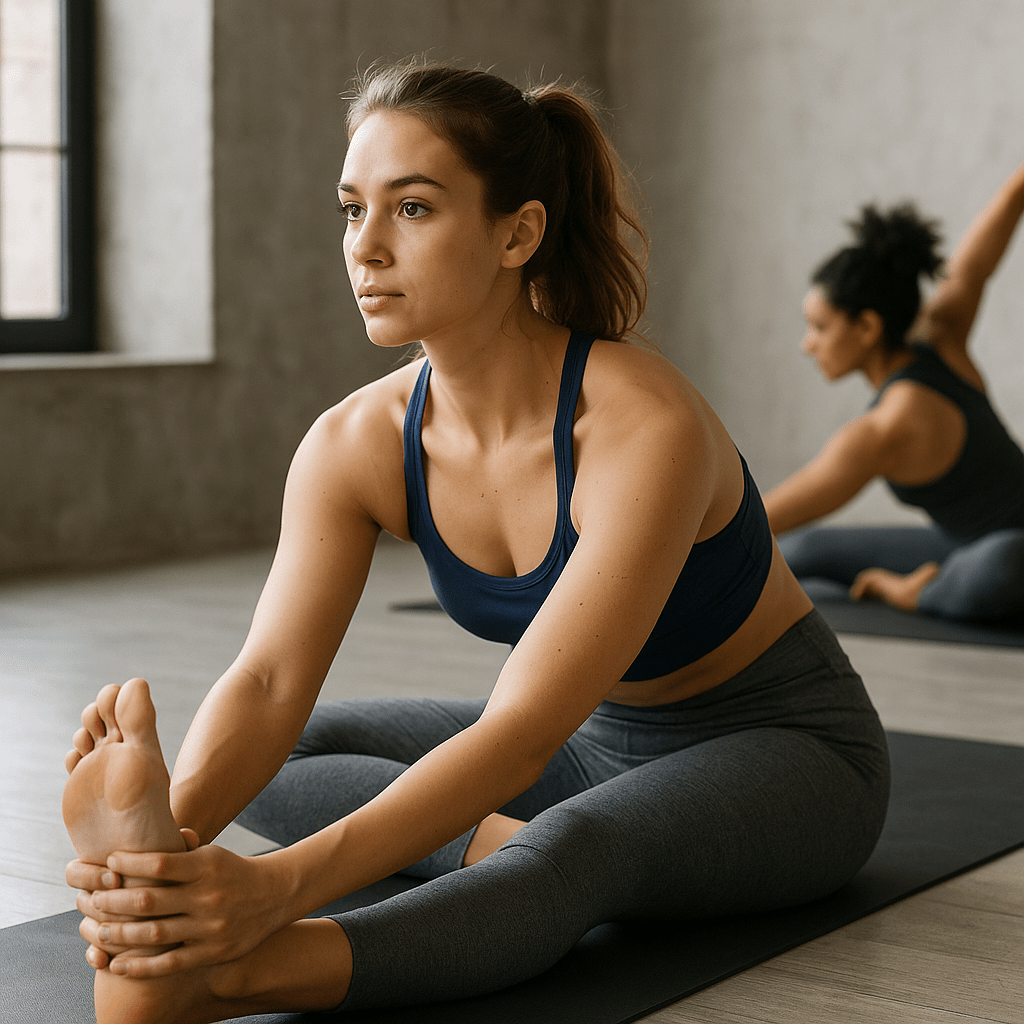
Seated Hamstring Stretch (30 sec/leg)
Sit on the floor, extend one leg, reach toward your foot. Keep your spine long.
Figure Four Stretch (30 sec/leg)
Lie flat on your back, cross one ankle over the other knee, and gently pull the leg that’s still on the ground toward your chest to stretch your hips deeply.
Chest Opener (1 min)
Clasp your hands behind your back, gently draw your arms away from your body, and open up through your chest.
Child’s Pose (1 min)
Sink down onto your knees, reach your arms forward along the floor, and softly rest your forehead down, allowing your body to unwind. Take slow, deep breaths.
Side-Lying Quad Stretch (30 sec/leg)
Lie on your side, pull your top foot toward your glutes. Keep knees close together.
Tip: Don’t bounce—stay relaxed, and breathe deeply into each stretch.
How to Know What You Need
Here’s a quick cheat sheet:
Goal/Activity Do This Before Do This After
Strength Training Dynamic (activation) Static (lengthening)
Running or Cardio Dynamic (mobility) Static (recovery)
Yoga or Pilates Gentle dynamic (flow) Deep static
Stress Relief Skip dynamic Static (relaxation)
Bonus Tips Just for Women
Pay attention to your cycle: During certain phases (like ovulation), your ligaments may be looser. Stretch gently.
Prioritize hips and spine: Women tend to carry tightness in the hips and low back, so make those areas a regular focus.
Be consistent: A few minutes each day makes a bigger impact than a 30-minute session once a week.
Conclusion: It’s Not One vs. the Other—It’s Both
Instead of asking “which is better?”, ask “when should I use each?”
Incorporating both dynamic and static stretching into your routine helps you build a more resilient, mobile, and flexible body—so you can move with confidence in your workouts and your everyday life.
Take 5–10 minutes before and after your workouts to care for your body. It’s a small investment with long-lasting rewards.
 Fitness Guide